 VECTOR STUDIOS
9 Multiagent System Design Patterns, From Baseline to Production
Multi-agent system design treats each capability as a specialised agent coordinated by an orchestrator and discovered via an agent registry. Before adding that complexity, prove the idea with a single-agent baseline and typed contracts, then layer in orchestration, memory, tool adapters, observability and evaluation traces as the Microsoft reference architecture describes them.
- Use parallel fan out only for independent subtasks; shared state writes can create consistency problems, while unnecessary pattern layers add latency without reliability.
- Keep routing, termination, and state transitions in versioned, validated objects; natural language should carry task content between agents, not execution control.
- Trace every model call, tool call, and handoff, then evaluate representative tasks; judging transcripts alone can miss failures that propagate downstream.
- Give each tool adapter scoped credentials, validate every handoff, minimize personal data, and require approval before agents write to production systems.
Vector Studios builds custom AI solutions with JARVIS, its orchestration platform, and provides strategy, implementation, and ongoing maintenance.
Explore AI Solutions →Table of Contents
- Essential design patterns for multi-agent systems
- Reference architecture: the building blocks you need
- How agents should talk to each other
- A staged rollout plan for shipping multi-agent systems
- What to measure and how to judge reliability
- What recent research means for how you build
- Security and privacy considerations in multi-agent interactions
- Integrating multi-agent systems with legacy infrastructure
- Deployment and real-time monitoring best practices
- Scalability challenges and solutions in multi-agent systems
- Three core rules for production systems
- How we can help you design and ship a multi-agent system
- FAQ
- Sources
Essential design patterns for multi-agent systems
Picking the right pattern matters more than picking the right framework. Each pattern below solves a specific coordination problem, and most production systems combine two or three rather than relying on one.
- Sequential pipeline: agents hand off work in a fixed order, like an assembly line. It gives clear handoff semantics and is the easiest pattern to debug because failures localise to one stage.
- Coordinator or dispatcher: a front-line agent routes requests to specialists, much like a concierge directing enquiries. It keeps decomposition logic separate from execution logic.
- Supervisor pattern: a dedicated agent decomposes a task, assigns subtasks, and synthesises the results, taking on responsibility that a plain dispatcher does not carry.
- Parallel fan-out and gather: independent subtasks run concurrently and converge at a join point. This cuts latency but only where subtasks genuinely do not depend on each other’s output, since parallel writes to shared state create consistency problems.
- Hierarchical decomposition: a top-level planner delegates to mid-level supervisors who delegate again, useful when a task naturally breaks into layers of abstraction.
- Generator and critic: one agent produces a draft, another evaluates it against explicit criteria before it is accepted or sent back.
- Iterative refinement: generator and critic loop repeatedly until a quality gate passes or a retry budget is exhausted.
- Human in the loop: a person approves, edits, or rejects an agent’s output at a defined checkpoint, usually where risk or ambiguity is highest.
- Composite patterns: most real systems nest these, for example a supervisor that fans out to three workers, each running its own generator-critic loop.
The failure mode to watch for is layering patterns without reason: a supervisor on top of a sequential pipeline that itself contains a dispatcher adds hops and latency without adding reliability. Match the pattern to a genuine coordination need, not to what looks architecturally impressive.
Reference architecture: the building blocks you need
A production multi-agent system is a set of specialised agents that collaborate through explicit coordination rather than one agent trying to do everything, and the Microsoft reference architecture names the components that make that coordination reliable: a semantic router, a dynamic agent registry, an orchestrator, local and remote execution paths, retrieval-augmented generation, persistent context, and standardised tool integration.
- Orchestrator: owns routing, lifecycle management, result aggregation and failure handling. It is the single most consequential architectural choice because it determines how tasks flow, how outputs combine, and what happens when an agent fails or times out.
- Agent registry: the source of truth for every agent’s identity, capabilities, operational status, version and metadata tags, according to the building blocks documentation. It lets the orchestrator discover the right agent for a task without hard-coding routing logic.
- Memory and persistent state: conversational context, retrieved knowledge, and an audit trail of what each agent did and why, which supports both continuity across turns and post-hoc debugging.
- Integration layer: adapters that handle tool authentication, input and output validation, error handling and monitoring for every external system an agent touches.
Each agent should be defined as a capability with a narrow responsibility, explicit tool permissions, an input and output schema, a version number, a health status and clear ownership, per the same building blocks guidance. Define the workflow contract first: task boundaries, typed inputs and outputs, ownership, termination conditions, retry policy and approval gates, before picking a framework, as the reference architecture repository recommends. Skipping this step is how teams end up with prompt-as-routing logic that breaks the moment someone edits a prompt.
How agents should talk to each other
Communication design determines whether a multi-agent system stays debuggable as it grows or turns into an opaque mess of retries and silent failures.
- Synchronous calls suit short, low-latency exchanges where one agent needs an answer before it can proceed, such as a classifier result.
- Asynchronous messaging suits longer-running work, background enrichment, or any step where the caller shouldn’t block.
- Typed control, natural-language data: represent execution-critical control (routing decisions, termination signals, state transitions) as typed, validated program objects, and keep natural language for the task content itself. Recent work on control-data flow separation shows that mixing the two causes prompt edits to silently corrupt execution protocols, whereas separating them produces stable, predictable behaviour.
- Semantic routing: a dedicated classification step that interprets intent and selects the right downstream agent, rather than leaving routing to an ad hoc chain of conditional prompts.
- Supervisor aggregation: when multiple agents contribute partial results, the supervisor’s job is to reconcile conflicting outputs explicitly rather than concatenating them and hoping the final consumer sorts it out.
The practical rule is to treat your message schema as a contract with the same seriousness as an API contract: version it, validate against it, and never let a model free-write into a field another agent will parse programmatically.
A staged rollout plan for shipping multi-agent systems
Multi-agent complexity should be earned, not assumed. A measured sequence catches problems while they are still cheap to fix.
- Build a single-agent baseline first and measure it honestly before assuming multiple agents will do better.
- Identify genuinely separable capabilities, meaning tasks with distinct inputs, outputs and failure modes rather than steps that happen to be describable separately.
- Define typed contracts and state ownership for every handoff, so each agent knows exactly what it receives, what it must return and who owns which piece of state.
- Implement one deterministic workflow before introducing any dynamic routing, so you have a known-good path to compare against.
- Add retries, timeouts, idempotency and cancellation semantics so a failed step doesn’t corrupt state or run twice.
- Instrument full traces across every model call, tool call and message before you need them for debugging.
- Evaluate on representative tasks, not hand-picked demos, before declaring the workflow production-ready.
- Introduce parallelism or dynamic routing only when metrics justify it: the 2026 literature on task-conditioned orchestration treats orchestration as a compiled, inspectable graph rather than a fixed topology, which keeps added complexity auditable instead of opaque.
Build in health checks for every agent, explicit version tags, idempotent operations, defined cancellation behaviour, and test cases that specifically exercise handoffs rather than only the happy path. Stage changes through unit tests, integration tests covering multi-agent flows, canary releases to a small slice of traffic, and a rollback plan that can revert to the previous deterministic workflow within minutes.
What to measure and how to judge reliability
Multi-agent systems fail in ways a single model call never does: an error in step two quietly degrades everything downstream. Instrumentation needs to capture the whole trajectory, not just the final answer.
- Model calls, tool calls and message traces between every agent, including inputs and outputs at each hop.
- Retries, latency, token usage and cost per agent and per workflow run, so you can see where a system is slow or expensive before a client notices.
- Failures and recovery actions, logged with enough context to reproduce them.
- Task success, grounding and tool correctness, tested against representative cases rather than judged purely on the final transcript.
Process-aware evaluation that records every state transition, approval and policy check produces far more actionable signals than transcript-only judging, and task-conditioned workflow graphs with environment-grounded gates catch failures that a final-answer check would miss. A newer technique worth adopting directly is propagation-aware uncertainty quantification: PropUQ-MAS models execution as a communication-structured graph and combines each step’s local uncertainty with uncertainty inherited from upstream messages, since errors propagate through agent graphs rather than staying contained.
PropUQ-MAS reports average relative gains of +6.10% in AUROC and +47.58% in PRR for its evaluated uncertainty estimates, a meaningful improvement in how reliably a system can flag its own weak steps before they cascade. Attaching uncertainty scores to intermediate messages lets you route uncertain outputs to a verifier, trigger replanning, or stop early rather than letting a shaky result flow silently to the next agent.
What recent research means for how you build
Two recent papers translate directly into engineering rules rather than staying theoretical. Control-data flow separation argues, with supporting empirical results, that representing control as typed program objects while keeping natural language strictly as data prevents the prompt drift that otherwise breaks routing and termination logic over time. Agyn models software engineering itself as an organisational multi-agent process, with role specialisation across coordination, research, implementation and review, combined with test-driven execution strategies, demonstrated through an open-source platform.
- Represent routing decisions, termination signals and state transitions as validated objects, never as free text a model can rephrase.
- Give agents narrow, named roles (reviewer, implementer, researcher) rather than one agent attempting every function.
- Pair generation with test-driven or grounded verification rather than a second model simply reading the first model’s output.
- Treat the orchestrator’s decomposition logic as a first-class, versioned artefact, not an emergent property of a long prompt.
Our own orchestration platform applies this same separation internally: typed routing contracts, a capability registry, and full execution tracing across every agent we deploy, which is also how we structure the systems we build for clients.
Treat the agent boundary the same way you’d treat a service boundary in any distributed system: with a contract, a version, and a test suite.
Security and privacy considerations in multi-agent interactions
Every agent-to-agent message is an attack surface, and a multi-agent system multiplies the number of trust boundaries compared with a single model call. Each tool adapter needs its own scoped credentials rather than a shared service account, so a compromised or misbehaving agent cannot reach systems outside its stated responsibility.
Input and output validation at every integration point matters as much as it does at any external API boundary, because an agent that accepts another agent’s output as trusted input without validation can propagate a prompt injection straight through the workflow. Logs and traces, which are essential for debugging, also tend to capture sensitive data, so access to trace stores needs the same controls as access to the underlying systems.
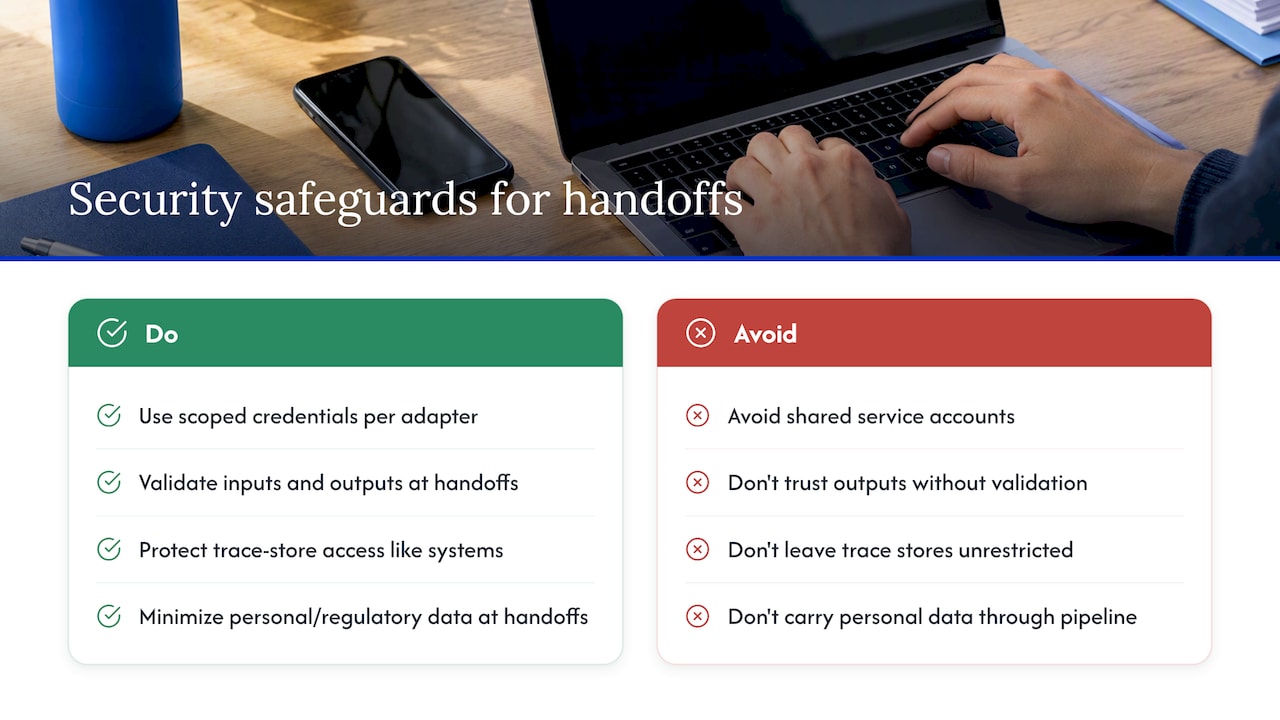
Personal or regulated data passed between agents should be minimised at each handoff rather than carried through the whole pipeline by default, and any agent with write access to production systems needs an approval gate or human-in-the-loop checkpoint before it acts, not after. None of this is specific to multi-agent systems, but the number of handoffs makes it easier to miss a boundary than in a single-model deployment.
Integrating multi-agent systems with legacy infrastructure
Most organisations are not building on a blank slate: an orchestrator has to sit alongside existing databases, authentication systems and workflow tools rather than replace them outright. The integration layer and its adapters, described in the reference architecture, exist precisely for this: each adapter handles the authentication, data mapping and error handling that a legacy system expects, so the agents themselves never need to know those systems’ quirks directly.
Start by wrapping legacy systems behind the same typed contract discipline you apply to agent-to-agent messages, rather than letting an agent call a legacy API with loosely structured parameters. This keeps the blast radius of a bad call contained and makes the integration testable in isolation.
Rolling out gradually, one legacy system at a time, with the single-agent baseline still running as a fallback, limits risk far more effectively than a full cutover. Legacy systems rarely expose the health checks or versioning metadata a modern agent registry expects, so budget time to build thin monitoring wrappers around them before connecting an agent directly to production data.
Deployment and real-time monitoring best practices
Deployment should mirror how any distributed system reaches production: staged rollout, canary traffic, and a rollback path that can revert within minutes rather than hours. Treat each agent as an independently deployable service with its own version and health status in the registry, so updating one agent’s logic doesn’t require redeploying the whole system.
Real-time monitoring needs to surface the same signals discussed earlier (latency, cost, failure rate, retries) at a dashboard level, not just in raw traces, so an on-call engineer can spot a degrading agent before it affects most traffic. Alerting thresholds should be set per agent rather than for the system as a whole, because one slow or failing agent in a fan-out pattern can otherwise hide inside an average that still looks healthy.
Canary releases that route a small percentage of real traffic to a new agent version, combined with automatic rollback triggers tied to error rate or latency thresholds, catch regressions before they reach every user. Keep a clear separation between staging and production registries so a misconfigured test agent can never be discovered by a production orchestrator.
Scalability challenges and solutions in multi-agent systems
Scaling a multi-agent system is rarely about raw throughput alone: it is about coordination overhead growing faster than the work itself as more agents and more handoffs enter the picture. Every additional agent in a pipeline adds a network hop, a potential failure point and a slice of latency, so scaling by adding agents without re-examining the topology tends to make a system slower, not faster.
Parallel fan-out and gather patterns scale throughput well for genuinely independent subtasks, but shared state becomes the bottleneck once several agents write to it concurrently, which is why state ownership needs to be explicit per agent rather than implicit. Caching retrieval results and tool outputs that multiple agents need repeatedly reduces redundant calls across a busy system.
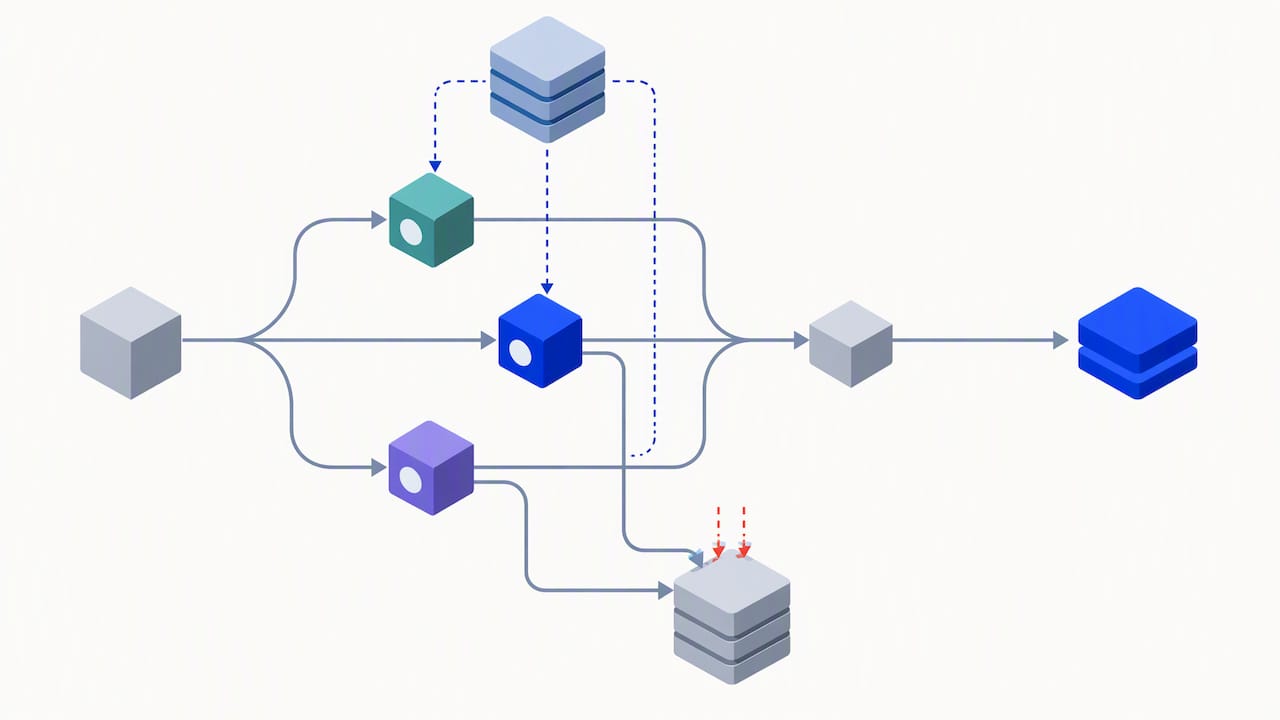
The agent registry itself needs to scale with the system: a registry that works for ten agents as a flat list becomes unmanageable at a hundred without capability tagging and versioned discovery, which is exactly why the reference architecture treats the registry as a structured source of truth rather than a static configuration file. Introducing dynamic routing and remote agent execution, as the task-conditioned orchestration approach describes, keeps scaling decisions inspectable rather than letting the topology grow organically and opaquely.
Three core rules for production systems
Prefer typed contracts over clever prompting every time a handoff matters: a schema catches a bad output before it propagates, a prompt instruction doesn’t. Prioritise observability and grounded verification over adding agents, because most multi-agent failures trace back to something nobody was watching, not to a missing capability. Defer parallelism until your metrics justify it: a correct sequential pipeline beats a fast but unreliable parallel one every time a client is depending on the output.
Start with a single agent. Add a second only when you can name, precisely, the capability it owns.
How we can help you design and ship a multi-agent system
Designing a reliable multi-agent system takes the same engineering discipline as any distributed system, plus the pattern judgement this guide has walked through. We built our orchestration platform, JARVIS, to run our own AI and game projects, which means the architecture advice above isn’t theoretical for us: it’s how we coordinate agents across our own work before we ever apply it for a client.

Through AI Strategy & Consulting, we help you scope which capabilities genuinely warrant separate agents. Through Custom Model Development and AI Integration & Automation, we build the typed contracts, registry and orchestration layer described above directly into your existing systems, and our Ongoing AI Support keeps monitoring and evaluation running once you’re live. If you’re weighing up a single-agent baseline against a full multi-agent architecture, get in touch with Vector Studios and we’ll help you work out which one your use case actually needs.
FAQ
No, ChatGPT as most people use it is a single large language model responding to a conversation, not a coordinated set of specialised agents. Some ChatGPT-based products add agent-like orchestration or tool use on top, but the base model itself does not include an agent registry or multi-agent orchestrator.
There is no single best framework: the right choice depends on your workflow contract, typed inputs and outputs, and ownership rules, which the reference architecture repository recommends defining before you pick a framework. Choosing a framework first and retrofitting contracts afterwards is a common source of prompt-as-routing failures.
ChatGPT is built on a large language model, and it becomes agent-like only when it is given tools, memory and the ability to take multi-step actions toward a goal. On its own, answering a single prompt, it behaves as an LLM rather than an autonomous agent.
Research examples include Agyn, which models software engineering teams as specialised agents handling coordination, research, implementation and review with test-driven execution. Production examples typically follow the pattern in the Microsoft reference architecture, combining a supervisor, specialised worker agents, retrieval, and an integration layer for external tools.