 VECTOR STUDIOS
Architecture Led Multi Agent Orchestration for UK Orgs with NCSC
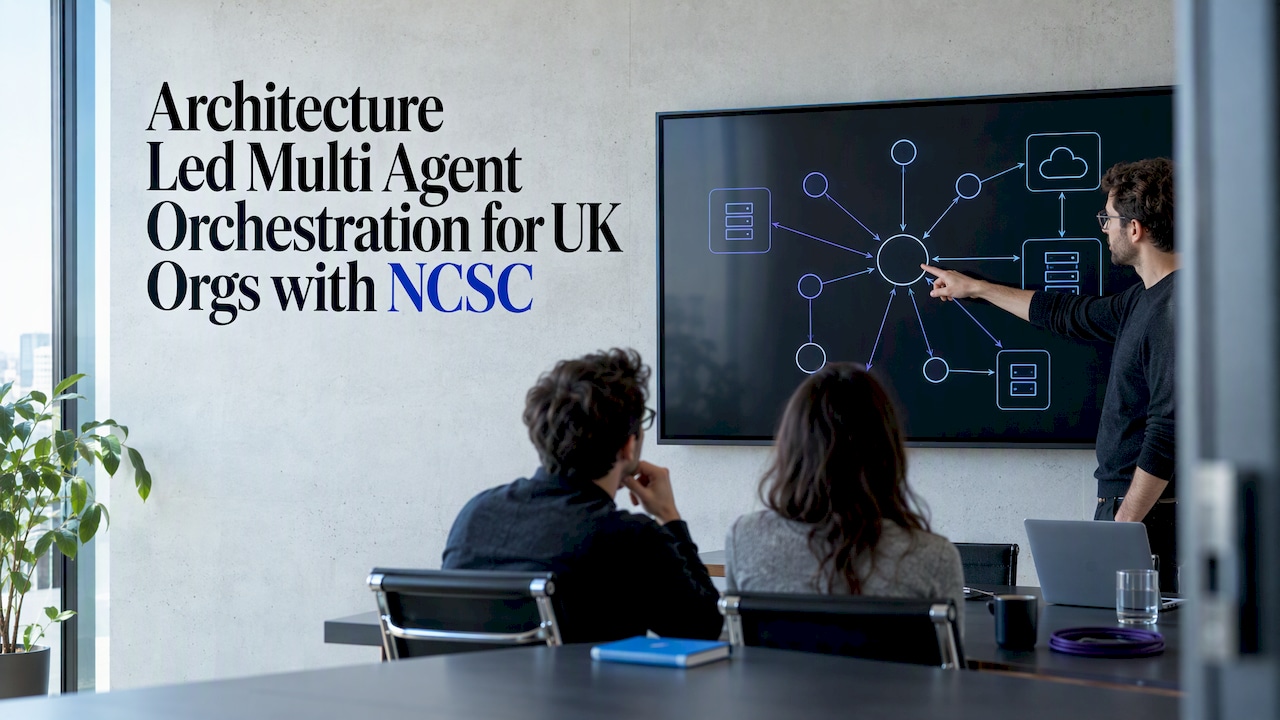
Multi-agent orchestration is a system design where a coordinating layer, the orchestrator, routes tasks between specialised AI agents so each handles a narrower piece of a larger workflow. It makes sense once a job is too varied or too parallel for one agent to handle reliably, and it adds real value for teams who can instrument, sandbox and govern what runs. Skip it for anything you cannot monitor or shut down quickly.
- Choosing the right architecture pattern affects cost, latency, and auditability, with hub-and-spoke ideal for small teams and peer-to-peer suited for low-latency needs.
- Clear runtime responsibilities and logs for orchestrator, worker, and judge agents are essential for effective debugging, governance, and failure containment.
- Standardized protocols like MCP and A2A facilitate interoperability, while a trusted, segmented architecture enhances security and resilience.
- Building on a governance-focused platform with role-based access and audit logging is safer than retrofitting governance onto a basic framework.
- Starting with small, bounded pilots, thorough instrumentation, and strict credential management prepares systems for safe, scalable production deployment.
Vector Studios designs custom multi-agent systems, integrates them into existing stacks, and supports them over time.
Explore AI Solutions →Table of Contents
- What is multi-agent orchestration and how does it differ from a single agent?
- Which architecture pattern fits your orchestration needs?
- How are responsibilities split between orchestrator, worker and judge agents?
- How do agents discover tools and talk to each other?
- Should you build on a framework or an orchestration platform?
- How do you move a pilot into safe production deployment?
- What security and governance controls does NCSC recommend?
- What are the best enterprise use cases for a first pilot?
- How is JARVIS used in practice, and what has it taught us?
- What should engineering teams do next?
- Where is multi-agent orchestration heading next?
- How we can help with strategy, integration and ongoing support
- FAQ
- Sources
What is multi-agent orchestration and how does it differ from a single agent?
A single-agent system is one model handling an entire task through one long prompt chain. It works for narrow, linear jobs but struggles once a workflow needs different skills, parallel branches or independent verification. Multi-agent orchestration splits that work across a coordinated team, each member with a defined role.
The common roles are:
- Orchestrator (or supervisor): plans the task, assigns work, and merges results.
- Worker (or specialist) agents: carry out a narrow function, such as retrieval, code generation or data extraction.
- Judge or oversight agents: check outputs against policy or quality criteria before anything ships.
Each run carries its own context: a step budget that caps how many actions an agent can take, and a synthesis stage where the orchestrator reconciles the workers’ outputs into one answer. This structure trades some simplicity for the ability to parallelise work and isolate failures to a single agent rather than the whole pipeline.
Which architecture pattern fits your orchestration needs?
Three patterns dominate production systems, and the choice shapes reliability, latency and how easily you can audit what happened.
- Hub-and-spoke: a central orchestrator dispatches tasks to workers and collects results; simple to reason about and easy to log, but the hub becomes a bottleneck at scale.
- Hierarchical (supervisor-worker): supervisors manage their own sub-teams of workers, which suits large or multi-domain workflows but adds coordination overhead between layers.
- Peer-to-peer: agents communicate directly without a central authority, which cuts latency but makes reproducibility and audit trails much harder to maintain.
Architecture matters more than most teams expect. The MAESTRO evaluation suite instantiated 12 representative multi-agent systems and found that architecture, not backend model choice, is what drives resource profiles and run-to-run variance.
Architecture is often the dominant factor in cost, latency and accuracy outcomes, according to MAESTRO’s findings, more so than which model sits behind each agent.
Practical signals for choosing: pick hub-and-spoke for small teams needing strong auditability, hierarchical for complex multi-domain workloads, and peer-to-peer only when latency is critical and you can accept weaker reproducibility guarantees.
How are responsibilities split between orchestrator, worker and judge agents?
Getting the division of labour right determines how easy a system is to debug and secure later. Each role needs a clear runtime contract.
- Orchestrator: owns task planning, routing decisions, policy-as-code enforcement, and the audit trail for every decision made.
- Worker agents: handle tool access requests, manage their own context window, respect iteration budgets, and report failures back rather than retrying silently.
- Judge or oversight agents: validate outputs against defined criteria, gate risky actions behind human approval, and flag anomalies for review.
- Human-in-the-loop checkpoints: triggered at defined risk thresholds, such as before an agent writes to a production database or sends external communications.
Every lifecycle event, task assignment, tool call, approval, failure, should be logged with enough context to reconstruct the run afterwards. This matters as much for debugging as for governance: a judge agent that silently approves everything is worse than no judge at all, because it creates false confidence in the system’s safety.
How do agents discover tools and talk to each other?
Interoperability between agents and tools depends on a small number of emerging standards rather than bespoke integrations for every system.
- Model Context Protocol (MCP) standardises how an agent discovers and calls external tools, replacing one-off API wrappers with a consistent interface.
- Agent-to-agent (A2A) protocols let agents exchange structured messages and delegate subtasks across different frameworks or vendors.
- Local MCP servers suit single-tenant, low-latency needs; shared MCP servers suit multi-team deployments but need strict tenant isolation to stop one team’s agent reading another’s data.
- Tool gateways wrap legacy APIs as agent-callable tools, applying schema validation and rate limits so an agent cannot call an internal system directly and unpredictably.
AWS’s architecture guidance for agentic systems recommends organising agents into trust zones, with communication between zones restricted to documented paths, schema validation and circuit breakers, so a failure or compromise in one zone cannot cascade into another.
Should you build on a framework or an orchestration platform?
Agent frameworks and orchestration platforms solve different problems, and conflating them is a common source of pain in production.
- Frameworks typically handle agent logic: prompt chains, tool definitions, reasoning loops and memory management.
- Platforms typically handle production governance: scheduling, role-based access control (RBAC), credential management, sandboxing and audit logging.
Most enterprise deployments end up hybrid: a framework for how agents reason, a platform for how they run safely at scale. When evaluating a platform, prioritise RBAC granularity, policy-as-code support, sandbox isolation levels and tamper-evident audit logs over feature breadth.
How do you move a pilot into safe production deployment?
Moving from a working demo to production requires a deliberate sequence rather than scaling a prototype directly.
- Start small: pick a tightly bounded workflow with clear success criteria before expanding scope.
- Define metrics upfront: latency, cost per run, failure rate and task success rate all need baselines.
- Sandbox every agent: restrict network access and credential scope to exactly what the task requires.
- Issue per-agent identities: use short-lived tokens rather than shared long-lived credentials.
- Instrument everything: a structured event bus, per-run telemetry and immutable audit logs are non-negotiable.
- Enforce policy-as-code: encode approval rules and risk thresholds rather than relying on manual review.
- Build human approval gates: for any action with real-world consequences.
- Prepare an emergency shutdown: and a tested incident response plan before go-live.
| Stage | Key control | Why it matters |
|---|---|---|
| Pilot scoping | Bounded task, defined metrics | Limits blast radius and proves value early |
| Runtime | Sandboxing, per-agent identity | Contains failures to one agent |
| Observability | Event bus, immutable logs | Enables debugging of non-deterministic runs |
| Governance | Policy-as-code, approval gates | Keeps humans accountable for risky actions |
What security and governance controls does NCSC recommend?
The UK National Cyber Security Centre’s implementation guide sets a clear bar: if you cannot understand, monitor or contain what an agent is doing, the system is not ready for production. That means integrating AI-specific threats into existing risk management rather than treating agent security as a separate discipline.
Operationally, NCSC’s guidance on managing agentic AI risk recommends:
- Apply least privilege and scope each agent’s permissions to the narrowest task it performs.
- Assign per-agent identities and credentials rather than sharing service accounts across agents.
- Use a sandbox maturity model, increasing network and compute isolation as an agent’s risk profile rises.
- Keep logs immutable and treat agent activity as user activity within existing monitoring and incident response.
- Maintain a tested emergency shutdown capability with clear human accountability for invoking it.
NCSC’s own framing is blunt: a system that cannot be understood, monitored or contained is not production-ready, regardless of how capable the underlying models are. That single test is worth applying before any other go-live checklist.
What are the best enterprise use cases for a first pilot?
Good pilots share a trait: bounded scope, measurable outcomes and low blast radius if something goes wrong.
- Document and data processing: extracting, validating and routing structured information from unstructured sources.
- Customer support triage: classifying and routing tickets, with a human handling anything escalated.
- Code review and testing assistance: agents flag issues for engineers rather than merging changes autonomously.
- Research synthesis: pulling and summarising information from internal knowledge bases for analyst teams.
Choose a pilot by scoring it against task boundedness, reversibility of actions and ease of instrumentation. Track success rate, cost per run and time saved, then expand scope only once telemetry shows stable, predictable behaviour.
How is JARVIS used in practice, and what has it taught us?
We have developed an orchestration platform, JARVIS, to coordinate specialist agents across various projects and internal game and AI development. It handles routing, context management and result synthesis across agents assigned to narrower jobs, from asset generation to NPC behaviour logic.
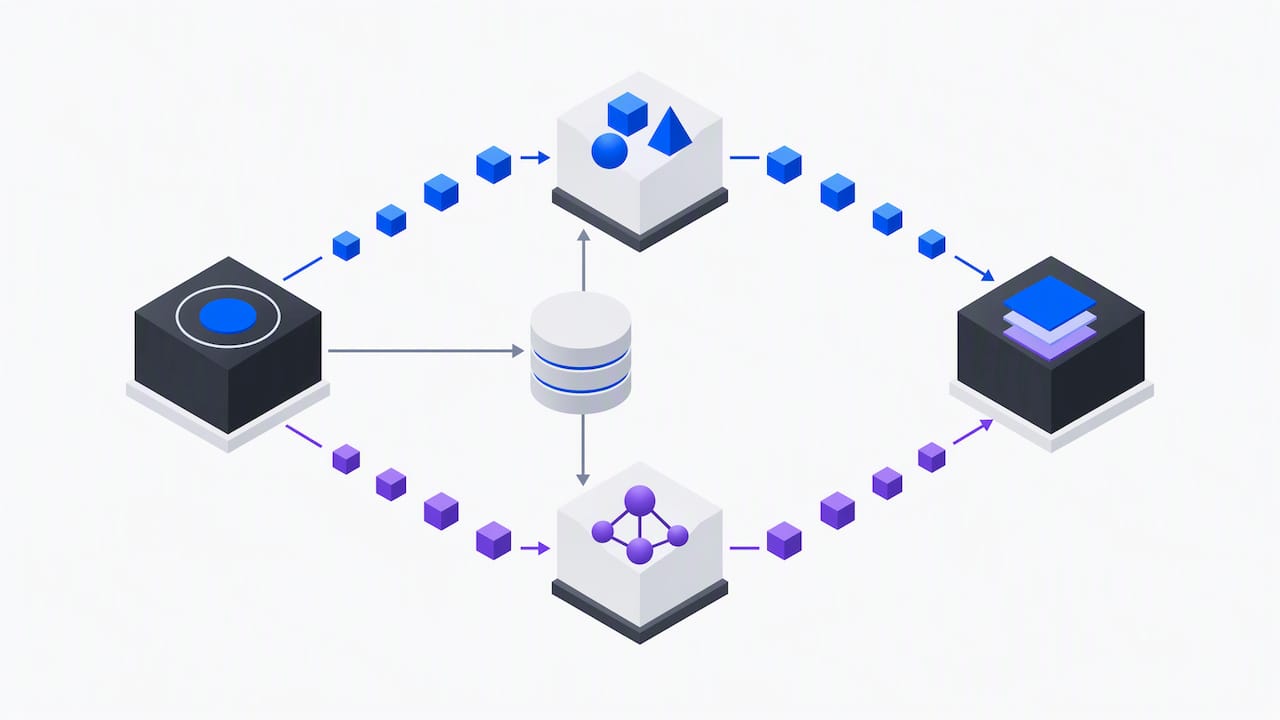
A consistent lesson from running JARVIS on real projects: scoping pilots tightly and instrumenting every run from the start saves far more time than optimising agent logic early. Governance choices, like per-agent credential scoping, pay off the moment a workflow needs to scale beyond a single team.
What should engineering teams do next?
A practical starting checklist:
- Run a small, bounded pilot before committing to a full build.
- Instrument every run with structured telemetry from day one.
- Lock down credentials with per-agent, short-lived tokens.
- Assign a named human owner accountable for each agent’s actions.
Bring in outside help when integrations touch sensitive systems, span multiple legacy platforms, or need to scale past what your team can govern confidently. Prioritise governance and observability investment ahead of adding more agents.
Where is multi-agent orchestration heading next?
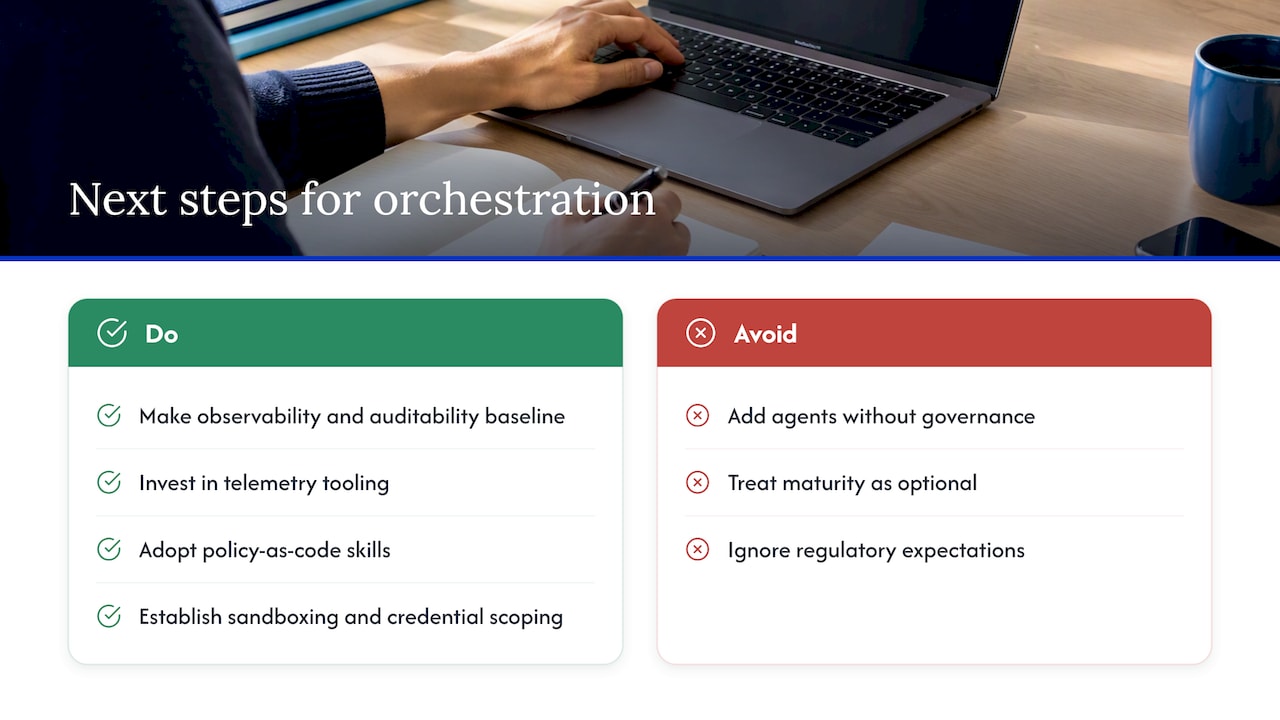
Expect regulatory attention to keep pace with deployment, with observability and auditability becoming baseline expectations rather than advanced features. Operational maturity, sandboxing, credential scoping and tested shutdown procedures, will separate production-grade systems from prototypes that quietly stall.
Teams that invest early in telemetry tooling and policy-as-code skills will adapt faster than those adding agents without the governance to match.
How we can help with strategy, integration and ongoing support
We work with teams building multi-agent systems, offering AI strategy and consulting to scope pilots, custom model development for specialist agents, and AI integration and automation to connect orchestration into existing operations. We also provide ongoing AI support to maintain governance and performance after launch.

If you are weighing up build-versus-buy for your own orchestration project, our AI, Games & Technology page outlines how we scope and deliver these engagements from strategy through to ongoing support.
FAQ
Multi-agent orchestration is a system design where a coordinating layer assigns tasks to specialised AI agents and merges their outputs into one result. It suits workflows too varied or parallel for a single agent, provided the system can be sandboxed, monitored and governed.
Subagent orchestration describes a hierarchical pattern where a supervisor agent delegates narrower tasks to subagents, each handling one part of a larger workflow. It is typically used for multi-domain tasks like document processing or research synthesis, where splitting work improves both speed and reliability.
Copilot products have introduced agent-based features for specific workflows, though the extent of multi-agent orchestration capability varies by product and release. Readers evaluating a specific Copilot offering should check the current product documentation for the orchestration features available at the time.
ChatGPT, as a conversational interface, is primarily a single-agent system responding to a user within one context. Some implementations built on top of it use multi-agent patterns, routing tasks to specialised agents, but the core product is not itself an orchestration platform.