 VECTOR STUDIOS
Engineers: Use Latency Aware LLM Orchestration to Cut Runtime 50%+
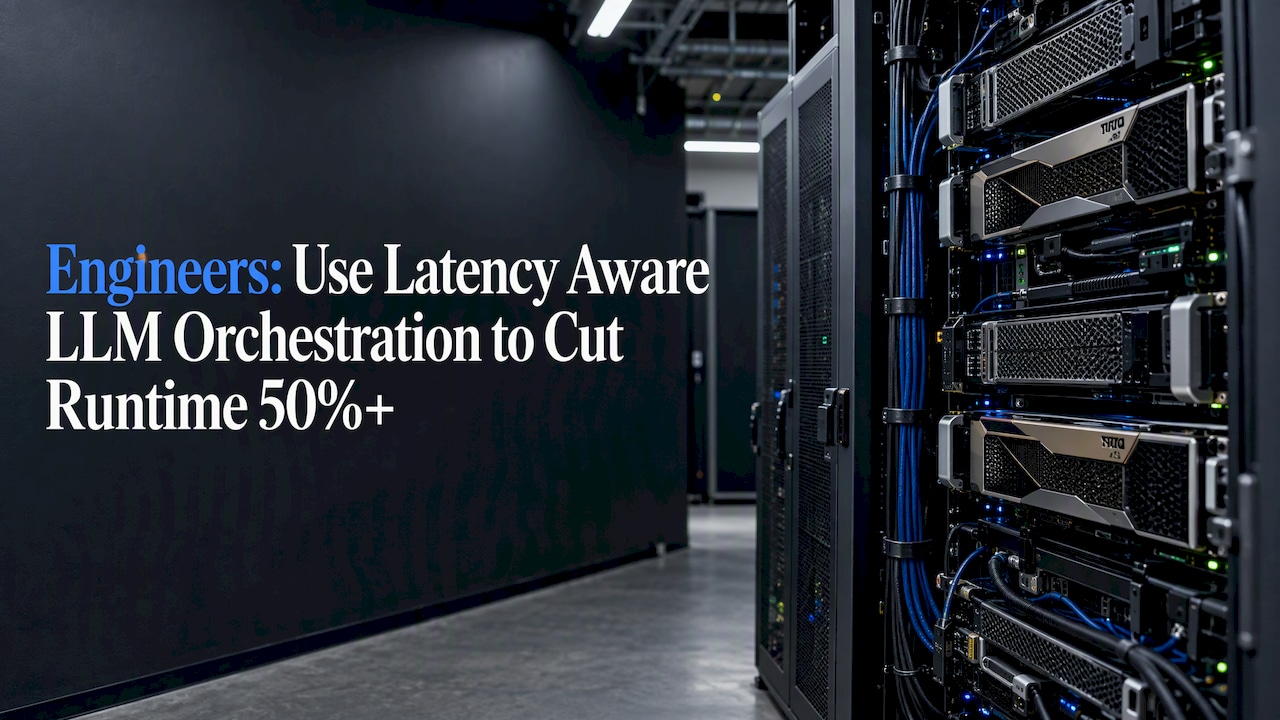
LLM orchestration is the control layer that coordinates models, tools and state so that large language model systems stay reliable and scalable once they leave the notebook. It covers prompt routing, tool dispatch, memory management and policy enforcement across multi-step tasks. An orchestration platform called JARVIS has been built to address these exact problems, and the practices below reflect what production LLMOps actually demands.
- Using a structured orchestration layer reduces latency and costs by avoiding unnecessary multi-step decomposition, especially for simple requests.
- Implementing strict tool schema validation and comprehensive observability from the start prevents critical failures and streamlines incident debugging.
- Latency-aware scheduling and prediction-driven resource management can cut total execution time by over 50 percent and improve SLO adherence.
- Combining developer frameworks with governance gateways offers both customization and centralized control, easing scaling and compliance management.
- Prioritize reliability and cost controls before optimizing for latency, and consider involving specialized teams for complex orchestration designs.
Vector Studios creates custom AI solutions with orchestration, integration, and ongoing support tailored to your stack.
Explore AI Solutions →Table of Contents
- How LLM orchestration works: core components and runtime responsibilities
- Orchestration patterns and when to choose them
- Frameworks and platforms: developer SDKs versus gateways
- Designing an orchestration system: state, memory and tool contracts
- Observability and LLMOps: what to measure and how to test for reliability
- Performance and scheduling: latency-aware orchestration
- Operational best-practices checklist and anti-patterns
- Vector Studios’ experience with orchestration and JARVIS
- Lessons learned and trade-offs
- How Vector Studios can help with orchestration builds
- FAQ
- Sources
How LLM orchestration works: core components and runtime responsibilities
At runtime, an orchestration layer takes on several jobs that a single LLM call never has to handle. It decides which model answers a given request, chains that answer into further steps when needed, calls external tools or APIs, tracks conversation and task state, retries failed steps and enforces policies such as content filters or spend limits. IBM describes orchestration as the coordination, chaining and monitoring of multiple LLMs, data sources and tools into a single working application, with prompt management, state and memory, multi-model routing and tool dispatch as its operational core.
Architecturally, most production systems settle on four parts. The orchestrator holds the logic that decides what happens next, whether that is a fixed workflow graph or an agent that plans dynamically. The runtime executes that logic, managing concurrency, timeouts and retries. Connectors handle the messy work of talking to vector databases, search APIs, code execution sandboxes and other LLM providers. A telemetry plane captures every step as an event so the system can be debugged and audited after the fact, something that becomes essential once a single user request might trigger a dozen internal calls.
A typical multi-step request might look like a directed acyclic graph rather than a straight line: a routing node decides whether a query needs retrieval, a retrieval node pulls context, a generation node drafts an answer, a validation node checks the output against a schema, and a final node decides whether to loop back or return. Frameworks such as LangChain and LlamaIndex expose primitives for exactly this kind of graph, with chains, retrievers and agents as building blocks that developers assemble rather than write from scratch.
The responsibilities an orchestration layer typically owns include:
- Prompt management: templating, versioning and injecting context into prompts consistently across calls.
- Model routing: sending each request to the right model based on cost, latency or capability needs.
- Tool dispatch: invoking external functions, APIs or retrieval systems and parsing their output back into the flow.
- State and memory: persisting conversation history or task progress across multiple calls.
- Retries and policy enforcement: catching failures, retrying with backoff, and applying guardrails before output reaches a user.
Frameworks like AutoGen approach this by giving each responsibility to a distinct agent role, while gateway-style platforms centralise routing and policy at the infrastructure layer instead. Either way, the responsibilities above do not disappear: they simply move to a different part of the stack.
Orchestration patterns and when to choose them
Not every task needs the same orchestration shape, and picking the wrong one is the most common source of wasted latency and spend. The two broad families are workflow-driven orchestration, where the sequence of steps is fixed in advance, and agent-driven orchestration, where a model decides the next step dynamically. Workflows suit predictable, well-scoped tasks such as document summarisation pipelines. Agent-driven approaches suit ambiguous, multi-stage tasks where the right sequence of actions cannot be known upfront, such as open-ended research or multi-tool troubleshooting.
Within agent-driven systems, the magentic manager pattern has become a reference design. A manager agent builds a plan, assigns sub-tasks to specialised worker agents, and tracks progress against a ledger. Microsoft’s Agent Framework documents this pattern with explicit support for stall detection, where the manager notices a worker has stopped making progress, and plan review, where a human or a supervising process can inspect and amend the plan before execution continues. This matters most on long, ambiguous tasks where blind execution risks running up cost without converging on an answer.
A newer technique, selective delegation, takes a different angle on the same problem. Rather than always decomposing a task into sub-tasks, a routing policy first checks whether the task is genuinely composite. Research on Uno-Orchestra frames this as a learned joint decomposition-and-routing policy: simple requests collapse to a single cheap model call, while only tasks that actually need multi-step reasoning get the full treatment. This directly improves the accuracy-efficiency frontier rather than treating every query as if it deserves the same orchestration overhead.
Three heuristics help teams choose quickly:
- Default to a workflow when the steps and their order are known in advance, since it is cheaper to run and far easier to test.
- Reach for an agentic manager pattern when the task is open-ended, multi-tool and likely to need replanning mid-execution.
- Add a cheap composite-check before invoking any multi-agent pipeline, so trivial requests never pay the overhead of full orchestration.
Frameworks and platforms: developer SDKs versus gateways
Developer frameworks and gateway platforms solve different halves of the orchestration problem, and conflating them leads to systems that are either hard to extend or hard to govern. AIMultiple’s survey of orchestration tools splits the landscape into developer frameworks, which are SDKs such as LangChain, LlamaIndex and Agent Framework offering agent primitives, chaining and retrieval-augmented generation helpers, and gateway or platform products, which sit in front of multiple model providers and handle routing, governance, audit logging and cost controls centrally.
Frameworks give engineers fine-grained programmatic control. They run inside the application itself, exposing classes and functions that developers compose directly into their codebase, which is why they suit teams building custom agent logic or novel retrieval pipelines. Gateways, by contrast, run as a layer between the application and the model providers, intercepting every call to apply policy, log usage and fail over between providers when one is degraded or unavailable.
In practice, production stacks tend to combine both rather than pick one:
- Framework inside the application for the actual agent logic, tool definitions and prompt chains that are specific to the product.
- Gateway as the control plane for cross-cutting concerns: multi-provider routing, spend limits, audit trails and compliance logging that need to apply uniformly regardless of which part of the application is calling out.
- Shared telemetry between the two, so traces from the framework layer and logs from the gateway layer can be joined for debugging.
This pairing avoids two failure modes at once: frameworks alone tend to leave governance as an afterthought bolted onto each project separately, while gateways alone give teams no good way to express complex agent behaviour. The combination lets a framework handle what is unique to the product and a gateway handle what has to be consistent across every product the organisation ships.
Designing an orchestration system: state, memory and tool contracts
State and memory design decides whether an orchestration system stays usable past the first few sessions. Short-term session memory, scoped to a single conversation or task, can stay in process memory or a fast cache. Long-term memory, meant to persist facts or preferences across sessions, needs its own store and, critically, a compaction and eviction policy: without one, context windows balloon, costs climb and retrieval quality degrades as irrelevant history crowds out what matters. A common pattern is to summarise older turns into a compact representation and keep only the most recent turns verbatim, evicting anything below a relevance or recency threshold.
Context engineering, the discipline of deciding exactly what goes into a prompt’s context window, matters as much as model choice for retrieval-augmented systems. This means scoring retrieved chunks for relevance before inclusion rather than stuffing in everything a similarity search returns, choosing a chunking strategy that respects document structure rather than splitting at arbitrary character counts, and leaving headroom in the context window for the model’s own reasoning rather than filling it entirely with retrieved text.
Tool contracts are where many orchestration systems quietly fail. When a model calls a tool, the arguments it generates need to be validated against a strict schema before execution, using something like Pydantic models or a JSON schema validator, rather than trusting the model’s output directly. Without this, malformed arguments cause downstream parsing failures or, worse, silent deadlocks where an agent waits indefinitely for a response that never arrives in the expected shape. A validation failure should feed back into the agent as a structured error it can act on, not crash the whole flow.
Fault tolerance follows the same logic as any distributed system, applied to model calls instead of network calls:
- Retries with backoff for transient failures such as rate limits or timeouts.
- Circuit breakers that stop sending traffic to a failing model or tool until it recovers.
- Stall detection that flags when an agent has made no progress after a set number of steps.
- Replanning triggers that hand control back to a manager agent, or to a human, when a stall is detected.
Agent Framework’s workflow primitives build several of these directly into the manager pattern, including progress ledgers that record what has been attempted and human-in-the-loop plan review for cases where automated replanning is not safe to trust.
Data governance cannot be an afterthought once tools start touching real systems. Access controls need to scope exactly what each agent or tool connector can read and write, and that scope should be the narrowest one that lets the task complete, since a compromised or misbehaving agent should never have blanket access to production data.
Observability and LLMOps: what to measure and how to test for reliability
Running LLM orchestration in production is an LLMOps problem, not a one-off deployment task. Oracle’s definition of LLMOps frames it as the ongoing discipline of maintaining, monitoring and aligning LLMs over time, distinct from traditional MLOps because of its evaluation complexity and the ways models drift in behaviour rather than just in accuracy metrics.
The metrics worth tracking as service-level objectives include latency percentiles rather than averages, since a system can have a fine mean latency while its p99 is unusable, token consumption per session as a direct proxy for cost, cost per session or per task to catch runaway agentic loops before they show up on an invoice, and task-level accuracy metrics specific to what the system is meant to do.
Tracing needs to go deeper than a single request log. Capturing per-step events, the evolving progress ledger in manager-pattern agents, and streaming telemetry as each tool call or model call completes gives engineers the ability to reconstruct exactly what an agent did and why, after the fact, rather than guessing from a final output alone.
Standardised evaluation surfaces problems that ad hoc testing misses. The MAESTRO evaluation suite finds that multi-agent system architecture, more than the choice of backend model, dominates resource profiles and reproducibility: the same workflow topology can be structurally stable yet show large run-to-run variance in latency, cost and failure rate, which is exactly the kind of variance that single ad hoc tests will not catch.
Remediation needs defined paths before an incident happens, not during one:
- Alerting on SLO breaches for latency, cost or error rate.
- Rollback to a previous orchestration configuration when a new pattern underperforms.
- Human-in-the-loop review gated on confidence thresholds or detected stalls.
Performance and scheduling: latency-aware orchestration
Latency compounds fast in multi-step orchestration, since every additional model call or tool round-trip adds its own tail latency to the total. Predicting which execution path a request will take, and preloading the models or tools that path is likely to need, cuts out a meaningful share of that compounding delay. Research on latency-aware orchestration shows that policies which predict execution paths and adapt scheduling accordingly can reduce end-to-end wall-clock execution time by over 50% and sustain SLO compliance of up to 99.9% under high load, compared with basic orchestration baselines that schedule naively.
On shared or heterogeneous GPU pools, scheduling decisions matter as much as the orchestration logic itself. A related line of work on prediction-guided runtimes builds a physical execution graph from the logical workflow by predicting device-specific activation latency and peak memory per step, then jointly optimises placement and execution order to cut p95 and p99 latency alongside total GPU-seconds consumed.
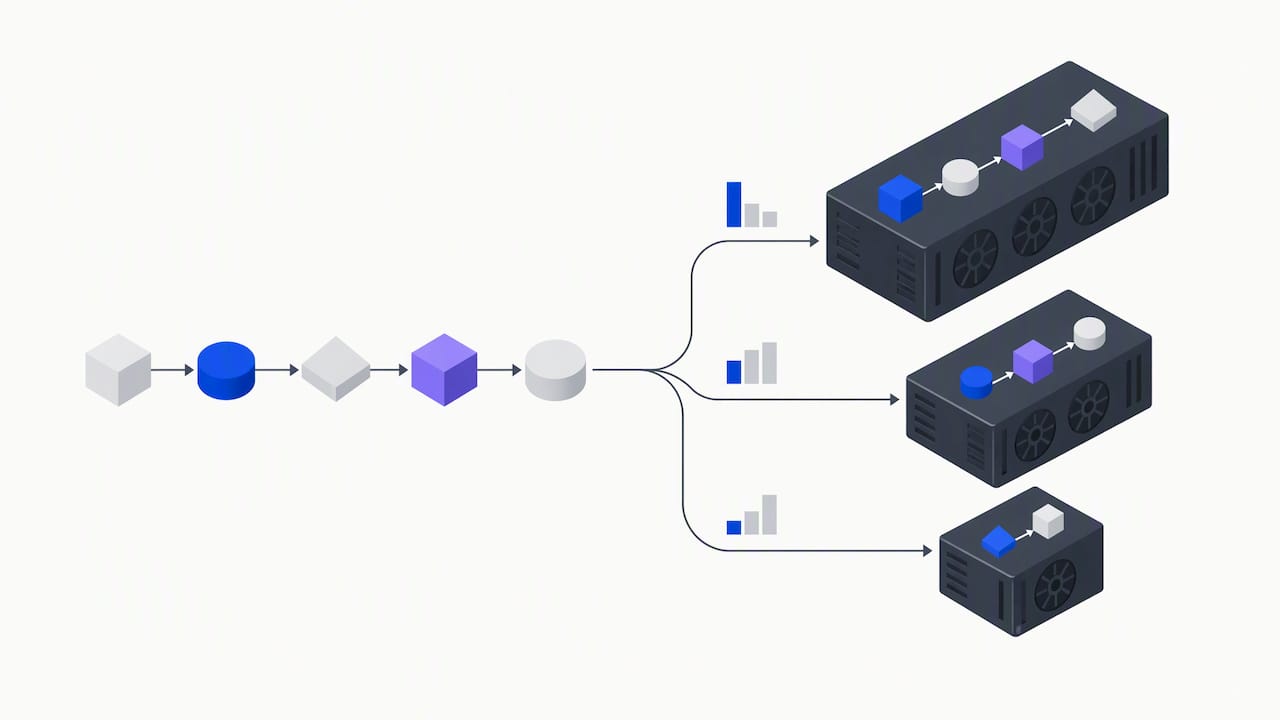
Fusing chains into a single call versus running separate calls is a genuine trade-off rather than an automatic win for fusion. Fusing reduces round-trip overhead and can shrink tail latency, but it also makes partial failures harder to isolate and retry individually.
The practical knobs worth tuning before anything more elaborate are:
- Prefetching, warming retrieval indexes or tool connections likely to be needed next.
- Model residency, keeping frequently used models loaded rather than paying cold-start costs repeatedly.
- Admission budgets, capping how many concurrent multi-step tasks the system accepts before queuing.
Operational best-practices checklist and anti-patterns
A short checklist catches most of the mistakes that show up in production orchestration systems after launch. Before deploying:
- Validate every tool schema with strict typing so malformed arguments fail loudly rather than silently.
- Wire observability hooks into every step before the first real user touches the system, not after an incident.
- Set budget limits on tokens, cost and concurrent tasks per session.
- Scope access controls narrowly for every agent and tool connector.
After deployment, review SLOs regularly, watch for behavioural drift as underlying models get updated, audit for reproducibility using trace-based evaluation such as MAESTRO, and alert on cost anomalies before they become a surprise invoice.
Several anti-patterns recur across teams building these systems for the first time:
| Anti-pattern | Consequence |
|---|---|
| Treating every query as multi-step | Unnecessary latency and cost on simple requests |
| No circuit breakers on tool or model calls | Cascading failures during a provider outage |
| Skipping memory compaction | Context windows bloat, quality and cost both suffer |
| No stall detection on agentic loops | Runaway token usage with no progress |
Responsibility for all of this rarely sits with one person. A dedicated LLMOps role, or at least a clearly assigned set of LLMOps duties, needs to sit between engineering, data and product teams so that handoffs, such as who owns a prompt change or a new tool integration, do not fall through the cracks.
Vector Studios’ experience with orchestration and JARVIS
An orchestration platform called JARVIS coordinates a range of AI agents across client projects and game and product development. Running it internally shaped some clear engineering habits: modular agent roles, so a routing failure in one agent does not take down the rest of the pipeline, heavy investment in observability from the earliest prototypes rather than bolted on later, and human-in-the-loop review gates for any agentic workflow touching production data or customer-facing output.
Running orchestration in production means treating every agent handoff as a potential failure point worth instrumenting, not an implementation detail.
The patterns described above, manager-style planning, selective delegation to avoid unnecessary overhead, and latency-aware scheduling, map directly onto the kind of multi-agent systems JARVIS coordinates. Teams building their own orchestration layer can take the same starting point: instrument first, simplify wherever a single call will do, and keep a human in the loop until the failure modes are well understood.
Lessons learned and trade-offs
Three lessons stand out from building orchestration systems in production. First, most latency problems trace back to unnecessary decomposition, not slow models, so a cheap composite-check before multi-agent dispatch pays for itself quickly. Second, observability that feels excessive during development becomes the only thing that lets you debug an incident at two in the morning. Third, reliability and cost pull in opposite directions more often than teams expect, and the fix is rarely “use a bigger model”.
Prioritise reliability first on anything touching customer-facing output, then optimise cost once the failure modes are understood, and treat latency as the constraint you negotiate last, since it usually improves as a side effect of fixing the other two. For builds complex enough that these trade-offs start interacting in ways that are hard to reason about alone, it is worth bringing in a team that has made these calls before.
How Vector Studios can help with orchestration builds
Teams that would rather hand off the engineering work than build an orchestration layer from scratch get a shorter path to production with a partner that runs this stack daily. A JARVIS-based approach is applied to client projects, meaning the patterns are already proven internally before they reach a client build.

The engagement shape typically runs from scoping through to ongoing support, matching the following services:
- AI Strategy & Consulting to define which orchestration pattern and architecture fit the task at hand.
- Custom Model Development for teams that need a model tuned to their own domain rather than a generic one.
- AI Integration & Automation to wire orchestration into existing systems and workflows.
- Ongoing AI Support to keep the system monitored, evaluated and maintained once it is live.
Details on each service, along with ways to get in touch, are on the Vector Studios services page.
FAQ
An AI orchestration model is the control logic that decides how multiple AI components, such as language models, tools and data sources, work together to complete a task. It covers routing, sequencing, state management and policy enforcement across what would otherwise be disconnected calls, as IBM’s orchestration explainer describes.
The right choice depends on whether a team needs a developer framework or a governance-focused gateway: LangChain, LlamaIndex, AutoGen and Agent Framework are widely used developer frameworks, while gateway platforms add multi-provider routing and cost controls on top, according to AIMultiple’s survey of orchestration tools. Vector Studios uses its own platform, JARVIS, for coordinating multi-agent workflows on client and internal projects.
LangChain and LlamaIndex are commonly used for chaining, retrieval and agent primitives, while Microsoft’s Agent Framework adds enterprise features such as session state, telemetry and the magentic manager pattern for planning and plan review. The right choice depends on whether a team needs lightweight chaining or built-in governance primitives.
Orchestration works by routing each request through logic that decides which model or tool should handle it, managing state and memory across steps, validating tool calls against a schema, and applying retries or policy checks before returning a result. More complex systems add a manager agent that plans multi-step tasks and tracks progress against a ledger, replanning when a step stalls.
Variance mostly comes from the workflow architecture itself, including agent count and communication pattern, rather than from the backend model alone. The MAESTRO evaluation suite finds that the same architecture can be structurally stable yet still show large swings in latency, cost and failure rate between runs.