 VECTOR STUDIOS
Inside JARVIS: Architecting a 10-Agent Autonomous Studio Nervous System
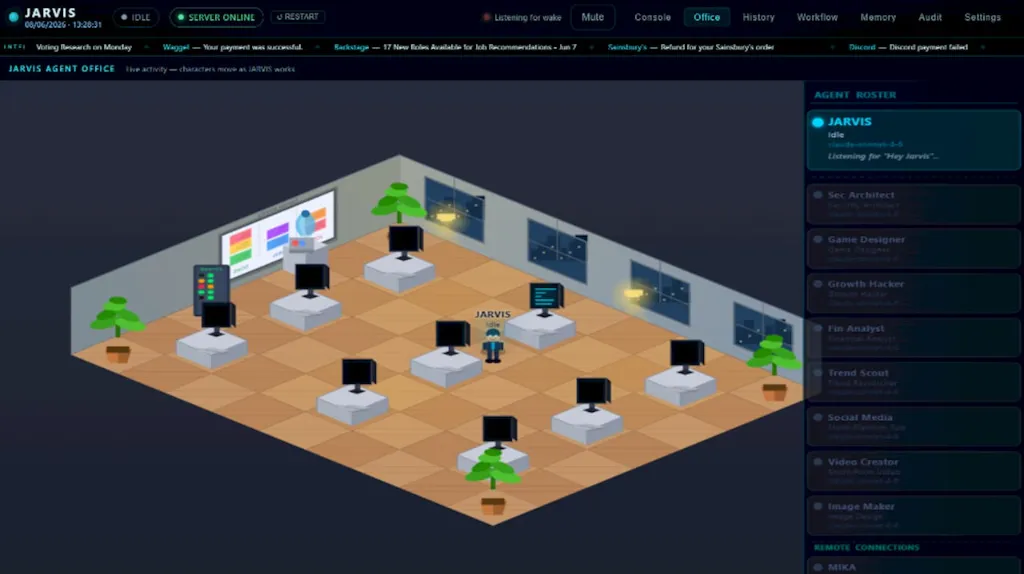
When we founded Vector Studios, we established a non-negotiable principle: the best technology companies are the ones that use their own tools every single day. JARVIS (Just A Rather Very Intelligent System) was born from our refusal to run a modern AI and game engineering studio with fragmented chat windows, disconnected spreadsheets, and manual context passing. Today, JARVIS coordinates a live roster of 10+ autonomous sub-agents across architecture, game design, security auditing, and media synthesis.
- Zero Context Passing: Persistent vector memory ensures agents always have full studio history without repetitive re-prompting.
- Tiered Compute Routing: Routing routine tasks to Claude Sonnet and high-complexity reasoning to Claude Opus yields a 65% cost reduction with zero degradation in analytical depth.
- Full Observability: A visual virtual office dashboard turns opaque multi-agent automation into an intuitive, observable studio workflow.
- Fail-Safe Sandboxing: Strict tool execution sandboxes ensure sub-agents cannot deploy unverified code without human-in-the-loop review.
Vector Studios engineers custom multi-agent operating systems that automate complex, multi-stage engineering and operational workflows.
Explore JARVIS Solutions →1. The Autonomous Peer-to-Peer Event Bus
Instead of treating Large Language Models as isolated question-and-answer terminals, JARVIS functions as a stateful event-driven orchestrator. A high-throughput Redis and WebSocket bus connects all agents into a unified virtual office. When a code commit lands or a new gameplay parameter is tuned, the event is broadcast across the mesh. Sub-agents evaluate domain relevance asynchronously, claim tasks via atomic distributed locks, and report telemetry back to the centralized studio dashboard.
2. The 10 Sub-Agents and Dedicated Operational Roles
Every sub-agent in JARVIS is assigned a specialized domain with calibrated system prompts, distinct tool permissions, and strict sandboxed execution boundaries:
- JARVIS Core: Master orchestrator, task decomposition, and ambient voice gateway.
- Sec Architect: Continuous AST static analysis, dependency supply-chain auditing, and zero-trust token isolation.
- Game Designer: Procedural balance curves, systemic mechanics modeling, and dialogue graph verification.
- Growth Hacker: Steam algorithm telemetry, conversion rate modeling, and organic distribution analytics.
- Fin Analyst: Real-time GPU compute expenditure tracking, API token telemetry, and financial runway modeling.
- Trend Scout: Real-time arXiv pre-print synthesis, GitHub trending tracking, and competitive intelligence.
- Social Media & Video Creator: Multi-platform automated publishing and short-form video montage rendering.
- Image Maker: Generative interface mockups, concept ideation, and visual asset style enforcement.
- MIKA: Secure edge proxy gateway handling external third-party webhooks and remote integrations.
3. Dual-Engine Intelligence: Claude Opus & Claude Sonnet
A critical design challenge in multi-agent systems is managing latency against reasoning depth. In JARVIS, we implemented a dynamic dual-engine routing matrix:
- Tactical Operations (Claude Sonnet): High-concurrency, time-sensitive tactical operations—continuous telemetry scraping, automated unit test generation, live radar updates, and social publishing—run on Claude Sonnet. Its exceptional sub-400ms time-to-first-token (TTFT) keeps the studio feeling instantly responsive.
- Strategic Reasoning (Claude Opus): Strategic architectural reasoning, zero-trust security audits, systemic game balance math, and multi-file refactoring execute on Claude Opus. Opus's extended reasoning tokens allow it to simulate multi-turn failure modes and verify invariants before any pull request is submitted.
4. Persistent Context Memory & Vector Cache
Standard conversational AI suffers from amnesia between sessions. JARVIS solves this by maintaining a dual-tier memory system. Short-term scratchpads are maintained in active working memory, while long-term architectural decisions, design decisions, and codebase conventions are indexed into a local vector embeddings store with hybrid semantic-BM25 retrieval. When any agent is spun up, it immediately pulls the historical context of every prior iteration.
5. Ambient Hardware Wake-Word & Live Dashboard
JARVIS does not require opening a browser window to interact. An edge acoustic model runs locally on studio hardware, continuously listening for the hardware wake word. When invoked, audio streams over low-latency WebSockets directly to the audio processing pipeline. Simultaneously, the pixel-art virtual office dashboard at jarvis.vectorstudios.uk visualizes each agent seated at their workstation, reflecting live CPU load, active task tickets, and real-time execution states.