 VECTOR STUDIOS
AI Teams: Build Human in the Loop Oversight Aligned to NIST, ICO
Human-in-the-loop (HITL) is an AI architecture in which a human reviewer must meaningfully approve or alter a system’s output before it takes effect. It typically applies to high-risk decisions such as medical diagnoses, credit approvals or biometric matches, where a mistake carries real consequences. Related models, human-on-the-loop and human-in-command, describe lighter forms of supervision that we unpack below.
- Human-in-the-loop systems are crucial for high-risk decisions because they prevent irreversible harm through human approval or editing before action.
- Approvals, active learning, reinforcement learning from human feedback, and annotation pipelines serve different stages of model development and deployment.
- Proper oversight requires clearly defined roles, decision interfaces, documentation, and ongoing training, not just superficial sign-offs.
- Over-reliance on HITL can lead to automation bias, fatigue, privacy risks, and systemic errors if oversight becomes inoperative or untrusted.
- Matching oversight levels to risk involves starting with strict HITL and gradually relaxing controls as model reliability is confirmed.
Vector Studios creates custom AI solutions with tailored models and multi-agent systems, supported by governance and ongoing maintenance.
Explore AI Solutions →Table of Contents
- How HITL works: approval gates, active learning, RLHF and annotation
- Taxonomy: the causal difference between HITL, HOTL and human-in-command
- When to use HITL: matching oversight to risk
- Benefits and limitations of HITL
- Designing oversight that works: roles, interfaces, training and DPIA
- Implementation patterns you can adapt: gates, active learning and RLHF
- Regulatory and compliance checklist: Article 14, ICO guidance and DPIA evidence
- Main risks and mitigations: bias, privacy and organisational failure
- How we put these oversight principles into practice
- The practical case for keeping humans in the loop
- Building this into your own AI systems
- FAQ
- Sources
How HITL works: approval gates, active learning, RLHF and annotation
Most HITL systems rely on one of a handful of mechanisms, each suited to a different stage of a model’s life.
- Approval gate: the model proposes an action (a transaction flag, a diagnosis, a generated reply) and a human must confirm or edit it before anything downstream happens.
- Active learning: the system identifies the examples it is least confident about and routes only those to human annotators, concentrating effort where it matters most.
- Reinforcement learning from human feedback (RLHF): human raters compare or score model outputs, and that feedback trains a reward model that steers a generative system towards preferred behaviour. It is common in conversational AI, where “correct” is a matter of tone and judgement rather than a single right answer.
- Annotation pipelines: teams write labelling guidelines, route the same item to multiple annotators, and resolve disagreements through consensus and quality checks before the labels feed a training set.
The approval gate is the clearest form of pre-action review: nothing happens until a person signs off. Active learning and annotation pipelines, by contrast, shape the model during training rather than intervening at the moment of each decision. RLHF sits between the two: it uses human judgement to adjust behaviour generally, rather than reviewing individual outputs one by one. Picking the right mechanism depends on whether the risk sits in a single decision or in the model’s general tendencies.
Taxonomy: the causal difference between HITL, HOTL and human-in-command
These three terms are used loosely, but a causal taxonomy gives them precise, useful meaning.
- Human-in-the-loop (constitutive): a human’s contribution is necessary for the output to exist at all. Nothing is finalised, published or actioned without that person’s input, which is why a causal taxonomy of human runtime involvement describes HITL as constitutive rather than advisory.
- Human-on-the-loop (corrective): the system acts autonomously, and a human monitors the stream of decisions, stepping in to correct or halt it when something looks wrong. The same taxonomy frames this as a supervisory, temporal mode rather than a per-decision gate.
- Human-in-command (authoritative): a person or body holds the standing authority to change how the system behaves, set its operating parameters, or switch it off entirely, a level above day-to-day review.
The distinction is not academic. A constitutive HITL gate adds latency to every decision and needs enough trained staff to keep pace with volume. A corrective HOTL setup scales further but demands real-time monitoring tools and a fast escalation path. Regulatory exposure follows the same line: a system that claims “human oversight” while actually running HOTL may not meet a standard that expects HITL for the highest-risk decisions.
When to use HITL: matching oversight to risk
Not every automated decision needs a human gate, and treating all of them the same wastes both money and expertise.
- Healthcare diagnosis, credit and lending decisions, biometric identification, legal judgments and safety-critical control systems typically warrant HITL.
- Start new deployments with tighter oversight, then relax towards HOTL or human-in-command as monitoring data confirms the model performs reliably and drift stays low.
- Weigh the trade-offs honestly: HITL slows throughput and costs more in trained reviewer time, but it catches edge cases that a purely automated system would miss.
- A simple heuristic: if an error could cause irreversible harm to a person, keep HITL; if errors are reversible and monitorable, HOTL may suffice; if the question is one of strategic control rather than individual cases, human-in-command is the right layer.
Dynamic configuration, tightening oversight during a model update or a period of drift and loosening it once performance stabilises, lets teams avoid paying for constant human review on a mature, well-monitored system.
Benefits and limitations of HITL
Done well, HITL improves how a system handles the cases that matter most, and gives organisations something to point to when a decision is challenged.
- Benefits: better handling of ambiguous or novel edge cases, space for ethical judgement a model cannot exercise, and an audit trail that supports accountability.
- Limitations: reviewer time is expensive and hard to scale, humans disagree with each other and with themselves over time, and routing sensitive data to reviewers raises privacy exposure.
- Operational pitfalls: automation bias, where reviewers rubber-stamp model suggestions instead of genuinely evaluating them, and reviewer fatigue from repetitive, low-signal review queues.
Research into feedback loops shows that automation bias and stabilising feedback loops can amplify small model errors into larger systemic problems when reliance on AI output goes unchecked. That is the strongest argument for treating HITL as an active design discipline rather than a box-ticking step: a gate that nobody really uses is worse than no gate, because it creates false confidence.
Designing oversight that works: roles, interfaces, training and DPIA
Oversight only functions when it is built, not bolted on.
- Assign clear roles and authority. Decide who can override a model’s output, how that override is recorded, and who is accountable when it turns out to be wrong.
- Design the reviewer’s interface around decision quality. Surface the inputs, the model’s confidence score and, where possible, a plain-language rationale, not just a final answer to rubber-stamp.
- Build in testing and red-teaming. The NIST AI Risk Management Framework recommends integrating human, technical and organisational controls together and defining clear roles for each human-AI configuration, warning explicitly against superficial oversight that exists on paper but not in practice.
- Plan for training, workload and logging from the start. Reviewer competence, caseload per shift and override records all need to exist as evidence before a data protection impact assessment (DPIA) is due, not assembled retrospectively.
Effective oversight is a measurable property, not a job title. The EDPS technical dispatch on human oversight sets out concrete conditions: reviewers need real capacity to intervene in time, access to the information relevant to the decision, and genuine agency to change the outcome. A reviewer who sees a bare “approve/reject” button with no context cannot meet that standard, however senior their title.
Implementation patterns you can adapt: gates, active learning and RLHF
A handful of recurring patterns cover most practical HITL deployments.
- Approval gate checklist: define the trigger condition, the reviewer’s required competence, a maximum response time, and what happens if no reviewer responds in that window.
- Active learning selection: route items where the model’s confidence sits near its decision boundary to human review first, since labelling those examples improves accuracy faster than labelling ones the model already handles well.
- RLHF pipeline sketch: generate candidate outputs, have raters rank or score them against written guidelines, train a reward model on that feedback, then fine-tune the generative model against the reward signal.
- Annotation QA: route each item to more than one annotator, measure agreement, and send disagreements to a senior reviewer rather than resolving them by majority vote alone.
Regulatory and compliance checklist: Article 14, ICO guidance and DPIA evidence
Meeting a regulator’s expectations means producing evidence, not just a policy statement.
- Treat high-risk systems as needing pre-action review. Article 14 of the EU AI Act sets an “effective oversight” standard for high-risk systems that goes beyond a token sign-off step.
- Document what “meaningful” involvement looks like. Under UK ICO guidance on explaining AI decisions, human involvement must be meaningful: reviewers need to be competent, empowered, and genuinely able to overturn an automated decision, and a DPIA should record their training and the stage at which they get involved.
- Keep audit evidence as you go. Logs of reviewer decisions, records of competence and training, and a clear trail of overrides are what an auditor or regulator actually asks to see.
- Run a simple internal checklist before deployment: who reviews, what they can see, how long they have, what happens on timeout, and where the override record lives.
Main risks and mitigations: bias, privacy and organisational failure
Oversight fails in predictable ways, and most of them have known countermeasures.
- Automation bias and fatigue: reviewers facing high volumes of low-value alerts start approving by default. Mitigate with sensible alert thresholds, periodic sample audits of approved decisions, and rotating reviewers so no one sits on the same queue indefinitely.
- Privacy exposure from review itself: routing sensitive records to human reviewers can leak personal data unnecessarily. Minimise what reviewers see and use redacted or synthetic views wherever the decision does not require the full record.
- Scapegoating a single reviewer when a system fails hides the real cause. Distribute oversight responsibility and run root-cause analysis on failures rather than treating them as one person’s error.
- Choosing an uninterpretable model for very high-stakes tasks makes oversight harder than it needs to be. Rule-based models or decision trees give reviewers an actual baseline to check the system’s reasoning against, something a credit scoring or hiring decision benefits from directly.
How we put these oversight principles into practice
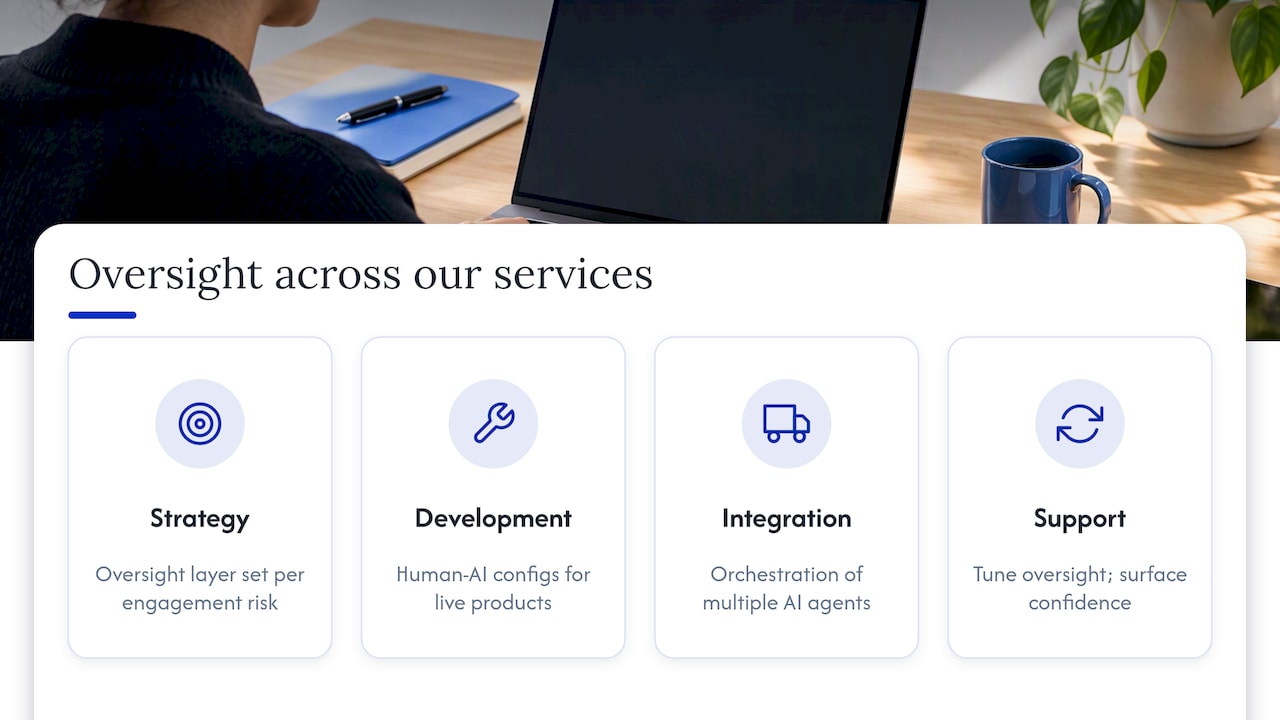
We build at the intersection of PC gaming and applied AI, which means we design human-AI configurations for both live products and client systems rather than just writing about them. The orchestration platform we use coordinates multiple AI agents across a workflow, and the same questions this article covers, who reviews what, how confidence gets surfaced, when to tighten or relax oversight, shape how we configure it for every engagement. Our services span AI strategy and consulting, custom model development, integration and automation, and ongoing support, each of which can include the oversight layer a specific risk profile calls for.
The practical case for keeping humans in the loop
The strongest argument for HITL is not ethics in the abstract, it is that well-designed human review catches the exact failures that automated metrics miss: the edge case nobody labelled, the context a model cannot see. The real skill is knowing where to loosen oversight as a system proves itself, rather than defaulting to maximum caution everywhere or removing it everywhere for speed. Teams that treat this as a dial, not a switch, end up with systems that are both faster and safer over time.
Building this into your own AI systems
If you are weighing up where HITL, HOTL or human-in-command fits your own product, that design work is exactly what our AI Strategy & Consulting and Custom Model Development services cover, alongside the integration and ongoing support needed once a system goes live. A typical engagement starts with an audit of current workflows, moves into a pilot with a defined oversight configuration, and ends with a roadmap for scaling it. Get in touch through Vector Studios to talk through what an initial engagement would look like for your system.

FAQ
Human-in-the-loop describes an AI workflow where a person’s input is a necessary part of producing or approving each output, rather than an optional check afterwards. It is most often used for high-risk decisions such as medical, financial or legal outcomes, where an error needs catching before it takes effect.
HITL is constitutive: a human must act for the decision to be finalised, which a causal taxonomy of human runtime involvement describes as necessary rather than supervisory. HOTL is corrective: the system acts on its own and a human monitors the output stream, stepping in only when something needs correcting.
It means a person reviews, edits or approves the AI system’s output before it has any real-world effect, such as confirming a flagged transaction or editing a generated draft. The goal is to catch mistakes a model would otherwise act on unsupervised.
Human-in-the-loop is an AI design pattern where a human reviewer’s judgement is required at the point of decision, not just during model training. Stanford HAI frames it as a deliberate design choice aimed at catching errors without creating unnecessary bottlenecks, rather than a limitation on the technology.