 VECTOR STUDIOS
Build Generative AI Systems in the UK Using Retrieval, Not Fine Tuning
Generative AI systems are machine learning systems that create new content such as text, images, audio, code or video by learning statistical patterns from large datasets. Unlike predictive or classification models, which sort inputs into known categories, generative systems model probability distributions over tokens or pixels and sample from them to produce original output. The sections below cover mechanics, architectures, design patterns, risks and UK regulation.
- Grounding retrieval in current, specific data reduces hallucination risk and improves accuracy in knowledge-based tasks.
- A well-designed system typically combines prompting, retrieval, and fine-tuning, with complexity added only if it delivers measurable improvements.
- Risks like bias, data poisoning, and sensitive data leakage require ongoing validation, content filtering, and compliance with UK data laws.
- Deployment choices depend on privacy, latency, and control needs, with options ranging from public APIs to local infrastructure, all requiring safeguards.
- Future trends include tighter retrieval and generation coupling, continuous safety monitoring, and transparent testing practices for compliance.
Vector Studios creates custom AI solutions, integrating tailored models and multi-agent systems into your existing infrastructure.
Explore AI Solutions →Table of Contents
- How generative AI systems work: training, tokenisation and tuning
- Core architectures: transformers, diffusion, GANs and multimodal models
- Where generative AI is used across text, image, audio and research
- System design patterns: RAG, retrieval and multi-agent orchestration
- Choosing how to deploy and integrate a generative AI system
- Risks, limitations and what UK regulation now requires
- Best practices for building and operating generative AI systems
- Vector Studios in practice: JARVIS orchestration and real workflows
- Perspective: near-term technical and governance trends to watch
- Ready to build your own generative AI system?
- FAQ
- Sources
How generative AI systems work: training, tokenisation and tuning
Every generative system starts with training: a model is exposed to enormous volumes of data and adjusts billions of internal parameters so that its predictions line up with patterns in that data. Scale matters, but so does quality. A larger dataset riddled with duplicates, errors or narrow sources tends to produce a weaker model than a smaller, carefully curated one, which is why data curation has become its own discipline inside AI teams rather than an afterthought.
Text and code models typically work by breaking input into tokens, which are chunks of characters roughly the size of a short word or word fragment. The model predicts the next token in a sequence, one at a time, based on everything that came before it. This is a probabilistic process, not a lookup: the model assigns a likelihood to every possible next token and then samples from that distribution.
Two settings control how that sampling behaves:
- Temperature adjusts randomness: a low value makes output more predictable and repetitive, a high value makes it more varied and occasionally incoherent.
- Top-k and top-p sampling restrict the pool of candidate tokens the model can choose from, trading creativity for reliability.
Once a base model exists, teams rarely use it unmodified. Instruction tuning trains the model to follow commands rather than simply continue text. Fine-tuning adjusts a pretrained model on a narrower, task-specific dataset, which can sharpen performance in a domain such as legal drafting or clinical notes. Reinforcement learning from human feedback, usually shortened to RLHF, goes a step further: human raters score model outputs, and those scores train a reward model that nudges the system towards answers people actually prefer. Each of these steps improves accuracy or safety but adds cost and engineering time, and a poorly supervised fine-tuning run can just as easily degrade a model’s general abilities as improve its specialism.
Many teams now reach for lighter alternatives before touching model weights at all. Careful prompting, few-shot examples embedded directly in a query, and retrieval-augmented generation (covered in detail further on) often close the gap between a generic model and a domain-specific one, at a fraction of the cost and with far less risk of unintended side effects.
Core architectures: transformers, diffusion, GANs and multimodal models
Most generative systems in production today are built on one of a handful of architectural families, each suited to a different type of output.
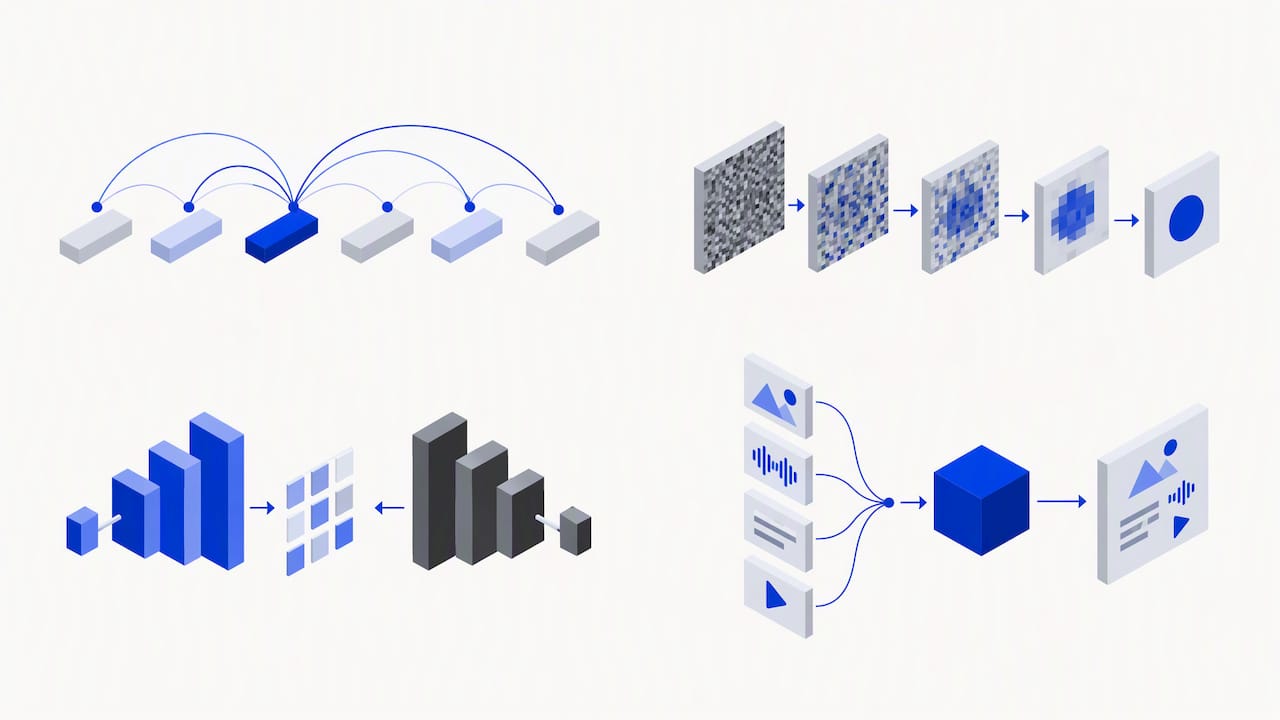
Transformer-based large language models dominate text, code and increasingly multimodal tasks. Their self-attention mechanism lets the model weigh the relevance of every other token in a sequence when predicting the next one, which is what gives them a workable handle on long-range context. Transformers scale well with more data and compute, but that scaling comes with steep infrastructure and energy costs, which is why organisations weigh model size against the task at hand rather than always reaching for the largest available option.
Diffusion models power most modern image generation and editing tools. They work by learning to reverse a gradual noising process: starting from random noise, the model iteratively removes it step by step until a coherent image emerges. This produces sharper, more controllable results than earlier approaches, though the iterative sampling process is slower than a single forward pass through a transformer, which is a real consideration for latency-sensitive applications.
Generative adversarial networks (GANs) pit two networks against each other, a generator producing samples and a discriminator judging whether they are real or synthetic. GANs were the dominant image-generation approach before diffusion models overtook them, and they remain useful in niche cases such as fast, low-latency synthesis or style transfer where training stability can be carefully controlled.
Variational autoencoders (VAEs) compress data into a lower-dimensional latent space and then reconstruct it, which makes them well suited to latent-space manipulation, anomaly detection and settings where interpretable, smoothly interpolatable representations matter more than photorealism.
A further distinction worth making:
- Unified multimodal models handle several input and output types, such as text and images, within a single network.
- Orchestrated specialist systems instead chain together separate models, each handling one modality, coordinated by a controller layer.
The unified approach is simpler to deploy but harder to specialise; the orchestrated approach costs more in engineering but lets each component be swapped, tuned or replaced independently.
Where generative AI is used across text, image, audio and research
Generative systems have moved well beyond chatbots into workflows across almost every sector that produces digital content or runs experiments.
- Text and language tasks: conversational assistants, document summarisation, translation, and code generation sit at the centre of most enterprise deployments, often doing the first draft of a task that a person then edits and checks.
- Images and design assets: creative teams use generative tools for concept art, product mockups, marketing visuals and targeted image editing, cutting the time between a brief and a usable draft.
- Audio and video: speech synthesis, voice cloning and music generation are increasingly common, alongside early-stage video generation tools used for prototyping rather than finished production work.
- Research and engineering: generative models assist materials discovery, physical simulation and automated experiment design, proposing candidate molecules or configurations that a human researcher then validates.
- Robotics and embodied systems: generative planning models help robots propose and evaluate action sequences in simulated environments before those actions reach physical hardware.
- Multimodal and tool-using applications: many production systems now combine a language model with function calling, letting the model query a database, call an external API or trigger a calculation mid-conversation rather than relying purely on what it learned during training.
The common thread across all of these is that generative output is a draft, not a final answer. The systems that work best in practice pair a capable model with a review step, whether that is an editor, an engineer or an automated check, matched to how costly a mistake would be in that particular context.
System design patterns: RAG, retrieval and multi-agent orchestration
A base model, however capable, only knows what was in its training data up to a cut-off point. Two design patterns have become the standard way to close that gap.
Retrieval-augmented generation (RAG) connects a model to an external knowledge source at query time. Documents are split into chunks, converted into vector embeddings, and stored in a vector database; when a user asks a question, the system retrieves the most relevant chunks by similarity and feeds them to the model alongside the original query. This grounds answers in current, specific information rather than relying solely on what the model memorised during training, and it is far cheaper than retraining a model every time underlying information changes.
Simple RAG retrieves once and generates once, which works for straightforward lookups but can fall short on complex, multi-part questions. Practitioners increasingly favour architectures where retrieval is woven more tightly into generation, refining what is retrieved as the answer takes shape rather than treating retrieval as a single upfront step, an approach that recent survey work on RAG methodology associates with better accuracy on complex queries.
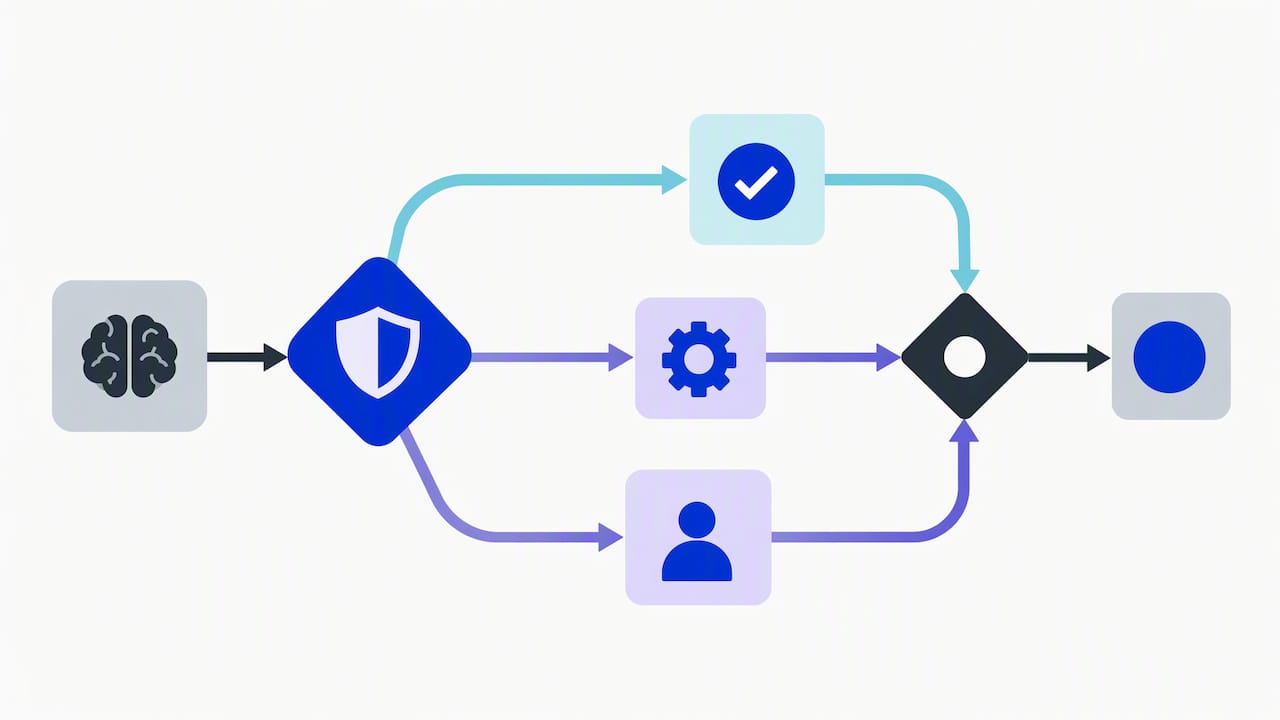
Agentic and multi-agent systems take this further by giving a model the ability to plan, call tools and delegate subtasks. A common structure splits responsibilities between a planner, which breaks a goal into steps, and one or more workers, which execute individual steps such as searching, calculating or calling an external API. Orchestration logic then sequences these steps and checks outputs before passing them along.
- RAG suits tasks where the main gap is missing or outdated knowledge.
- Multi-agent orchestration suits tasks that require multiple steps, tool use or coordination between specialised capabilities.
- Compositional systems, chaining several specialised models rather than relying on one monolithic multimodal model, give more control at the cost of more integration work.
Choosing how to deploy and integrate a generative AI system
Once a model and design pattern are chosen, the next decision is how the system actually reaches users, and this choice shapes cost, latency, data control and how quickly something can ship.
Public APIs and managed cloud model services offer the fastest route to market. A team can call a hosted model within days rather than months, but takes on dependency on a vendor’s pricing, availability and model updates, some of which can shift output behaviour without warning.
Embedded enterprise assistants, built into existing software such as a CRM or document platform, bring generative capability directly into a worker’s existing tools. These deployments typically require careful access control lists and defined data scopes so that a model only sees and generates within the information a given user is authorised to access, alongside whatever enterprise licence terms govern that integration.
Self-hosted endpoints and local inference keep data within an organisation’s own infrastructure, which matters for privacy-sensitive workloads and can reduce latency for high-volume use. The trade-off is heavier engineering overhead: hosting, scaling and maintaining inference infrastructure is a meaningfully different job from calling a hosted API.
- Public APIs suit fast prototyping and low initial engineering investment.
- Embedded assistants suit workflows already anchored in existing enterprise software.
- Self-hosted or local deployment suits privacy-sensitive or latency-critical workloads.
- Hybrid gateway patterns, routing requests across multiple vendors or models through a unifying layer, suit organisations that want to avoid single-vendor lock-in while still comparing model performance.
Government guidance on generative AI describes exactly this range of deployment patterns, from public web services and embedded applications through to local development and cloud solutions, and recommends safeguards such as content filtering and validation checks regardless of which pattern an organisation chooses.
Risks, limitations and what UK regulation now requires
Generative systems fail in particular, recurring ways, and understanding those failure modes is the first step towards managing them.
Hallucination is the generation of plausible-sounding but false or unsupported content, a structural consequence of a model predicting likely next tokens rather than checking facts against a verified source. Bias arises when training data reflects historical or societal skew, which the model then reproduces or amplifies in its outputs. Data-poisoning risk covers the possibility that training or fine-tuning data has been deliberately manipulated to shift model behaviour. Data leakage describes a model inadvertently reproducing sensitive information it was trained or prompted with.
Practical mitigations include:
- Content filtering on both inputs and outputs to catch unsafe or sensitive material before it reaches a user.
- Input and output validation checks, including redaction of personal or confidential data.
- Grounding outputs in retrieval so claims can be traced back to a verifiable source document.
- Human review for any output used in a high-stakes decision.
The HMG Generative AI Framework recommends recording prompts and responses and collecting metrics on hallucination rate, toxicity, fairness and robustness as a standard part of testing before any production deployment, treating safety evaluation as an ongoing measurement practice rather than a one-off sign-off.
Organisations developing or deploying generative AI must also work within UK data protection law. UK GDPR and the Data Protection Act 2018 already govern how personal data can be processed, and a 2026 statutory instrument requires the ICO to prepare a code of practice specifically addressing the use of personal data in AI and automated decision-making, with particular emphasis on protections for children’s data. Organisations building generative systems that touch personal data should expect to demonstrate, not just assert, that they have considered data minimisation, purpose limitation and a documented basis for any automated decisions a system contributes to.
Best practices for building and operating generative AI systems
Treating a generative system as a one-off build rather than a maintained product is the single most common way these projects go wrong.
- Scope the problem tightly before picking a model, clarifying what the system must do and what it must never do.
- Select an architecture and deployment pattern matched to that scope, rather than defaulting to the most capable available model.
- Customise through prompting, retrieval or fine-tuning, in that order of preference, only adding complexity that measurably improves results.
- Test before launch using a mix of unit tests on individual components, integration tests across the full pipeline, red-team adversarial testing to probe for unsafe outputs, and real user validation.
- Deploy with access controls and logging in place from day one, not added retroactively.
- Monitor continuously for drift, hallucination rate and user-reported issues once live.
- Iterate on the system based on what monitoring surfaces, closing the loop back to scoping.
Governance matters as much as the technical build. Reproducible artefacts, meaning a clear record of which model version, prompt templates and data sources produced a given output, make audits and incident response possible. Access controls limit who can change a system’s behaviour, and audit logs let a team reconstruct what happened when something goes wrong.
Safety engineering deserves particular attention for high-risk outputs: guardrails that block certain categories of response, fallback strategies that degrade gracefully rather than failing silently, and human-in-the-loop review for decisions with real consequences for a person’s finances, health or legal standing.
Vector Studios in practice: JARVIS orchestration and real workflows
We built Vector Studios around the same patterns described above, applying them first to our own products before offering them to clients. Our orchestration platform coordinates a diverse range of AI agents across both our internal development and the custom systems we build for clients, which means the multi-agent patterns we recommend are the same ones running our own workflows day to day.
In practice, this looks like:
- Multi-agent orchestration that splits complex tasks between specialised agents rather than relying on one general-purpose model.
- Domain grounding through retrieval and fine-tuning tailored to a client’s own data and terminology.
- Controlled fine-tuning applied only where prompting and retrieval fall short.
- Integration engineering that connects a generative system into a client’s existing tools and infrastructure rather than leaving it as a standalone demo.
A typical engagement moves from strategy and architecture choices through custom model development, integration into live operations, and ongoing support once a system is in production.
Perspective: near-term technical and governance trends to watch
The next shift in generative AI is less about bigger models and more about tighter coupling between retrieval and generation, with systems that refine what they retrieve mid-answer rather than once upfront. Expect continuous safety monitoring to become standard practice rather than a pre-launch checklist, as embedded assistants and managed enterprise platforms spread into more day-to-day tools. Statutory guidance is still catching up with the technology, which means the organisations in the strongest position will be the ones that can already show their testing and data-handling practices on request, not just describe them.
Ready to build your own generative AI system?
If you are weighing up whether to build in-house, hire a specialist or buy an off-the-shelf tool, our work spans AI strategy and consulting, custom model development, AI integration and automation, and ongoing support once your system is live, so you are not left maintaining it alone. We apply the same multi-agent orchestration and domain-grounding patterns described above to client projects, tailored to your data and existing operations rather than a generic template.

Get in touch through our services page to talk through what a generative AI system could look like for your organisation.
FAQ
Yes. ChatGPT is a generative AI system built on a transformer-based large language model that generates text token by token in response to a prompt, rather than classifying or retrieving pre-written answers.
Generative AI systems include large language models that produce text and code, diffusion models that generate and edit images, and audio and video generation tools used for speech synthesis and music. They also include multimodal systems that combine several of these capabilities, and retrieval-augmented or multi-agent systems built on top of a base model.
Generative AI is commonly grouped by core architecture into transformer-based models, diffusion models, generative adversarial networks (GANs) and variational autoencoders (VAEs). Each suits different outputs: transformers for text and code, diffusion for image generation, and GANs and VAEs for more specialised image synthesis and latent-space tasks.
Platform rankings shift quickly and depend heavily on the task, whether that is text generation, image creation or code assistance, so a single definitive list is not reliable. A more useful approach is to match a platform’s strengths, such as context length, multimodal support or fine-tuning options, to your specific use case rather than choosing by general reputation alone.