 VECTOR STUDIOS
AI Data Pipelines: UK Compliance Meets JARVIS Engineering

A data pipeline for AI is an automated system that ingests, transforms, and continuously delivers data for both model training and live inference rather than a one-off batch job that moves data from a database to a report. It differs from a classic ETL pipeline because it must handle unstructured data, keep lineage for every transformation, and support continuous retraining as models drift. The rest of this guide walks through the engineering decisions that make that possible.
- Version feature definitions and serve training and inference from the same feature store; snapshot each training dataset to reproduce results and debug failures.
- Use streaming for logs and user events, scheduled batch pulls for reference data, and storage suited to access: object, columnar, vector, or cached.
- Record lineage for every dataset and embedding, label synthetic examples, and separate research from deployment processing with distinct lawful basis decisions.
- Enforce retention automatically, such as anonymizing or deleting data after 12 months while retaining versioned datasets for reproducibility and audits.
- Track drift, null rates, and schema violations, validate new models through canary or shadow tests, and keep rollback paths ready before full deployment.
Vector Studios develops custom AI solutions, high-throughput feature stores, and multi-agent systems, from architecture to ongoing support.
Explore AI Solutions →Table of Contents
- What an AI data pipeline does and why it matters
- How AI pipelines differ from traditional data and ML pipelines
- Stage-by-stage engineering breakdown for building AI pipelines
- Governance, lineage and privacy in AI data pipelines
- Monitoring, observability and retraining for AI pipelines
- LLM and RAG considerations for data pipelines
- Vector Studios’ practitioner pattern for pipeline delivery
- Engineering perspective: where to focus first on a new pipeline project
- How Vector Studios can help build and run your AI data pipeline
- FAQ
- Sources
What an AI data pipeline does and why it matters
An AI data pipeline covers the full span from historical training data to the live request a model answers in production. It pulls raw inputs from source systems, cleans and restructures them, generates the features a model needs, and then serves those same features consistently at training time and at inference time. That symmetry is the whole point: a model trained on one version of a feature and served a slightly different one in production will behave unpredictably, a failure mode engineers call training-serving skew.
Traditional ETL pipelines were built for structured, tabular data moving on a nightly schedule into a warehouse. AI workloads break that assumption in three ways: a large share of the input is unstructured (text, images, logs, audio), the pipeline needs a feature store or equivalent to keep training and serving features aligned, and the system has to support ongoing retraining rather than a single load. Gartner has warned that a lack of AI-ready data is a leading risk to AI projects, which puts the engineering of the pipeline itself, not just the model, at the centre of whether a project succeeds.
Done well, an AI-native pipeline gives you three practical gains:
- Reproducibility: you can recreate the exact dataset a model was trained on, which matters for debugging and for audits.
- Data freshness: features reflect current reality rather than a stale weekly snapshot, which keeps predictions relevant.
- Reduced drift: consistent feature definitions across training and serving cut down on the silent accuracy loss that comes from mismatched data.
How AI pipelines differ from traditional data and ML pipelines
An AI data pipeline, as IBM frames it, is built to ingest, process and deliver data formatted specifically for AI and machine learning training, retrieval-augmented generation indexing, and real-time inference. That framing pulls in requirements a conventional data warehouse pipeline rarely had to meet.
- Multi-modal support: text, images and audio need parsing and often vectorisation before a model can use them, not just column mapping.
- Lineage and reproducibility: every training run and every served prediction needs a traceable path back to its source data.
- Continuous retraining: pipelines run on an ongoing cycle rather than a single load, which means scheduling, validation and rollback all need to be built in from the start.
- Latency and storage trade-offs: a feature that takes seconds to compute offline often needs a cached, millisecond-level lookup when served live.
Metadata enrichment and context engineering, including converting unstructured content into vectors for retrieval, have become a standard part of this picture wherever generative systems sit downstream of the pipeline.
Stage-by-stage engineering breakdown for building AI pipelines
Breaking the pipeline into stages makes the design decisions concrete. Each stage carries its own trade-offs, and getting one wrong tends to surface as a mysterious accuracy problem two stages later.
- Ingestion. Decide batch versus stream per source. Logs and user events usually suit a stream, often via a Kafka-style message bus that preserves ordering within a partition; reference data from a CRM or warehouse usually suits scheduled batch pulls. Build connectors that tolerate schema drift at the source rather than failing silently.
- Preprocessing. Parse unstructured inputs (documents, images, transcripts) into a consistent schema, and use schema-on-read where source formats vary. Synthetic data and augmentation can fill gaps for rare classes, but they need to be labelled as synthetic in lineage metadata so nobody mistakes them for real observations later.
- Feature engineering. Separate offline features (computed in batch, used for training) from online features (computed or fetched at request time). Version every feature definition, and expose features through a feature store so training and serving code read from the same source of truth rather than two parallel implementations.
- Storage. Raw and intermediate data typically sit in object storage; structured training sets suit columnar formats for fast scanning; embeddings for retrieval workloads need a vector database. Hot data that serves live traffic belongs in a fast, cached tier, while cold historical data can sit in cheaper storage, since cost and latency pull in opposite directions here.
- Training. Snapshot the exact dataset used for each run, track experiments with their parameters and metrics, and make dataset creation reproducible so a model can be retrained on demand with the same inputs, not an approximation of them.
- Deployment. Choose online inference for latency-sensitive requests and batch inference for bulk scoring. Budget for feature-fetch latency at serving time, cache aggressively where features change slowly, and keep serving features consistent with the versions used in training.
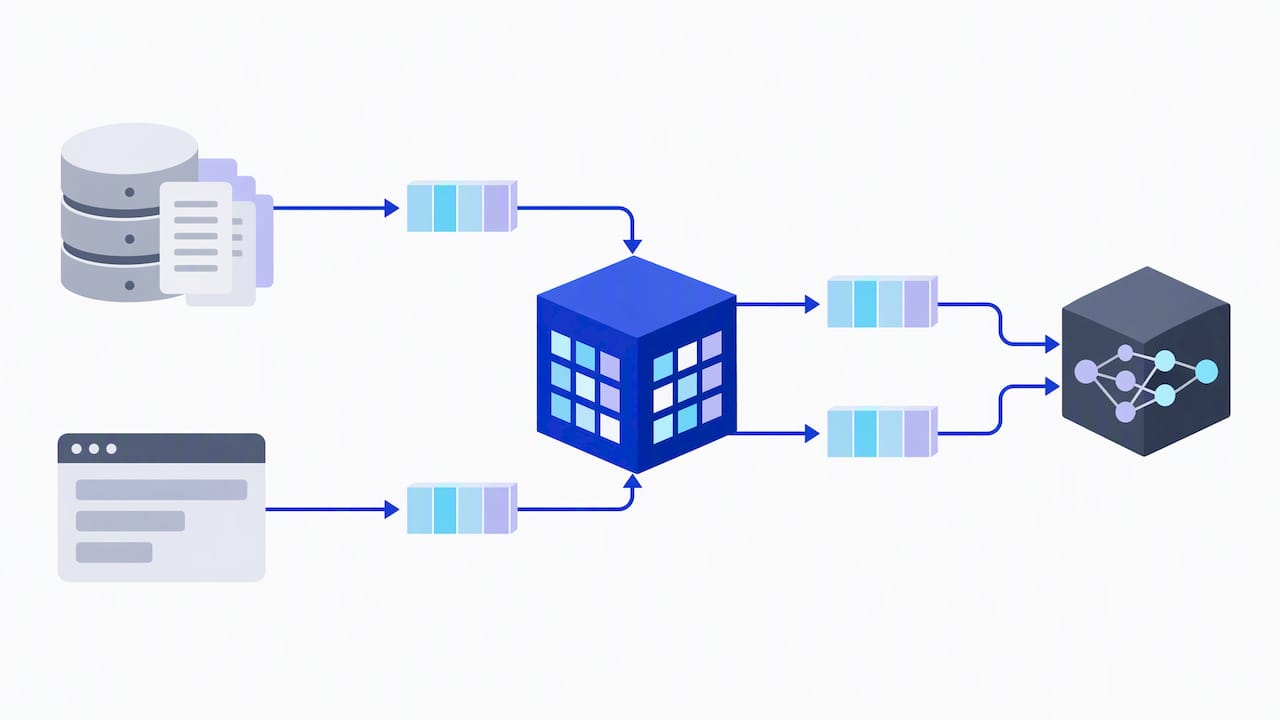
Ray Data illustrates one practical approach to the processing layer underneath several of these stages: it is a scalable, AI-first data-processing library that supports streaming execution and efficient handoff between CPU and GPU work, which matters for multi-modal batch inference and last-mile preprocessing before a model actually runs. A mapping study of AI data engineering literature describes a comparable operational recipe: streaming ingestion into a raw zone, schema-on-read preprocessing, materialised feature tables for offline training, and a minimal online feature API with cached lookups for serving, a pattern that prevents training-serving skew while keeping serving latency low.
Governance, lineage and privacy in AI data pipelines
Reproducibility and compliance turn out to be the same engineering problem viewed from two angles. If you can trace exactly which data produced a given model version, you have both an audit trail and a debugging tool.
- Record lineage and provenance for every dataset used in training or inference, with automated tracing rather than a manually maintained spreadsheet.
- Treat data minimisation as a feature-selection audit: review which fields a model actually needs, rather than deleting data indiscriminately.
- Apply retention schedules with automated enforcement, for example anonymising or deleting data beyond a 12-month window while keeping versioned datasets for reproducibility, an approach the ICO’s data minimisation guidance describes as balancing GDPR obligations with model performance.
- Separate the processing operations and lawful-basis decisions for research and development from those for deployment, which the same ICO guidance notes simplifies compliance assessment considerably.
Separating R&D and deployment processing operations reduces compliance risk, according to the ICO, because each operation can be assessed against its own lawful basis rather than one blanket justification covering very different activities.
A data protection impact assessment belongs inside the pipeline design process itself, not as a document written after deployment. The ICO’s lifecycle guidance on fairness sets out checks across project design, data collection, preprocessing, model development, evaluation, deployment and decommissioning, which maps closely onto the stages described above. Building those checks into pipeline gates, rather than treating them as a separate compliance exercise, keeps engineering and governance moving at the same pace.
Monitoring, observability and retraining for AI pipelines
A pipeline that worked at launch will not stay correct on its own. Production AI systems need the same monitoring discipline as any other critical system, plus a few signals specific to machine learning.
- Track distributional drift and feature drift against the training baseline, along with label skew and basic data-quality counters such as null rates and schema violations.
- Run continuous validation before anything reaches full traffic: canary inference on a small slice, shadow deployment that compares a new model’s output against the live one without acting on it, and automated tests on known cases.
- Set retraining triggers deliberately, whether scheduled, threshold-based on drift metrics, or gated by a human reviewer, and add guardrails so a noisy signal does not trigger constant retraining.
- Keep rollback paths and experiment-tracking records ready, so a bad model version can be reverted as quickly as it was shipped.
LLM and RAG considerations for data pipelines
Pipelines feeding large language models and retrieval-augmented generation systems carry their own operational quirks on top of everything above.
- Version the embedding encoder itself, not just the data, since swapping encoders without re-indexing silently breaks similarity search.
- Decide between batch and streaming embedding generation based on how fast your source content changes, and plan a re-index strategy rather than assuming embeddings stay valid indefinitely.
- Budget vector database latency as part of the serving path, and choose a similarity metric deliberately rather than defaulting to whatever the library ships with.
- Design chunking and context strategies so retrieval-time context matches what the model saw during any fine-tuning, since a mismatch here degrades answer quality in ways that are hard to diagnose later.
- Track provenance for embeddings the same way you track it for raw data, since a vector carries information from its source text even after conversion.
Vector Studios’ practitioner pattern for pipeline delivery
AI data pipeline work can be organised around checkpoints rather than a single handover, using orchestration approaches to coordinate ingestion, feature-store updates and multi-agent training workflows as connected stages instead of isolated scripts.
- Data versioning is enforced at every stage so a training run can always be traced back to its exact inputs.
- DPIA sign-off and validation gates sit before any model moves from staging to production traffic.
- Rollouts happen in stages, with a canary slice before full deployment.
Typical deliverables may include a pipeline blueprint, a feature-store schema, a retraining policy and the runbooks needed to operate the system afterwards.
Engineering perspective: where to focus first on a new pipeline project
Start with reliable inputs, lineage and a small, versioned set of features rather than trying to automate everything on day one. Teams that chase full automation before their data sources are trustworthy end up automating noise. Keep components modular so a change to feature engineering does not quietly break the serving path. Bring in specialist help for DataOps, compliance or orchestration once the pipeline needs to scale past what a single team can monitor by hand, not before.
How Vector Studios can help build and run your AI data pipeline
If you recognise the gap between a working prototype and a pipeline that holds up under production traffic, that is exactly where our services sit. Through AI Strategy & Consulting, Custom Model Development, AI Integration & Automation and Ongoing AI Support, we take a pipeline from blueprint through to a production-ready system, including feature-store design, retraining automation and the compliance checklists your DPO will want to see.

Get in touch for a scoping conversation or a health review of the pipeline you already have.
FAQ
An AI data pipeline is an automated system that ingests, processes and delivers data in the format a model needs, for both training and real-time inference. It differs from a standard data pipeline by handling unstructured data, maintaining lineage, and supporting continuous retraining rather than a single batch load.
The common stages are ingestion, preprocessing, feature engineering, storage (including a feature store), training and deployment. Each stage feeds the next, and consistency between the training and serving paths at the feature-engineering and storage stages is what prevents training-serving skew.
Start by mapping your data sources and deciding batch versus stream ingestion for each, then build preprocessing that handles your specific unstructured formats before adding feature engineering with versioned definitions. From there, choose storage that fits your latency needs, set up reproducible training with dataset snapshotting, and add monitoring before you consider the pipeline production-ready.
A common pattern streams raw events into object storage, applies schema-on-read preprocessing, materialises feature tables for offline training, and exposes a minimal online feature API with cached lookups for serving, a structure described in research mapping AI data engineering practice. This keeps training and serving aligned while allowing each stage to scale independently.
Check whether the tool or vendor supports lineage tracking, feature versioning and the specific data types your project needs, since gaps here are hard to retrofit later. It also helps to ask how retraining and rollback are handled, since a pipeline without those is incomplete regardless of how well ingestion works.